On Building Reliable Agents
The individual principles behind reliable agents are not new—and the field knows it. Anthropic's "Building Effective Agents" [3] established that workflows and constraints outperform unconstrained autonomy. Their subsequent work on context engineering [90] and agent harnesses [91] codified progressive disclosure and structured state management. OpenAI's practical guide [9] converges on the same patterns. DSPy [92] formalized the shift from prompting to programming. The Bitter Lesson discourse [93][95] has been applied specifically to agent scaffolding. Context engineering as a discipline has its own rapidly growing literature [30][94]. The building blocks are well-understood.
Yet capability and reliability are diverging. Rabanser et al. [113] evaluate fourteen frontier models across eighteen months of releases and find that while benchmark accuracy has improved steadily, agent reliability—consistency across repeated runs, robustness to rephrased instructions, predictability of failure modes—has barely moved. Models are getting smarter; agents are not getting more dependable. This gap is the central motivation for this paper: reliability is not primarily a model capability problem—it is a structural one.
If unreliability is structural, then the fix is structural too. The pattern is already visible in production: the agents that work—coding agents that run tests before committing, data pipelines that validate schemas at each step, orchestrators that checkpoint state and retry from known-good positions—succeed not because they use smarter models, but because they impose structure that compensates for model limitations. Constraints narrow the space of possible failures; external validation catches errors that self-reflection misses; composable, well-scoped tools reduce the cognitive load on the model at each step. Structure converts a probabilistic system into a more predictable one—not by eliminating the stochasticity, but by containing it within boundaries where its consequences are manageable. The question, then, is not whether to add structure, but what kind, where, and how much.
Consider what this means concretely. Building consistency means building reliable operators—reusable structural units that enforce uniform behavior. A map operator that transforms every row in a dataset using the same model call and the same criteria is the agentic equivalent of a SIMD instruction: one operation, applied uniformly, with consistent semantics across all inputs. But the lack of such operators is only the most obvious symptom. Watch a coding agent refactor a module and you will routinely find leftover dead code it forgot to clean up, additive patches layered on top of existing logic instead of proper restructuring, and inconsistent criteria applied to similar cases within the same task. These are not capability failures—the model can do better on any individual instance. They are structural failures: the absence of operators, validation passes, and architectural constraints that would enforce consistency across the full scope of the work. The argument of this paper is that by building structured agents within a deliberate framework, we can address these failure modes systematically—improving reliability without sacrificing the flexibility that makes agents useful in the first place.
What has been missing is a coherent mental model. The field suffers from widespread semantic confusion: "agent," "tool," "context," "state," "memory," and "planning" are used inconsistently across frameworks, papers, and products—often meaning different things in different contexts, or conflating concepts that should be distinct. LangChain's "agent" is not Anthropic's "agent" is not an academic "agent." A "tool" in one framework is a "skill" in another and an "action" in a third. "Memory" might mean the context window, a vector store, a conversation log, or persistent state, depending on who is speaking. This confusion is not merely terminological—it leads to architectural mistakes, because builders inherit muddled abstractions and wire systems together without a clear picture of what each component is and how it relates to the others.
This paper attempts to cut through that confusion by proposing an organized mental model for thinking about agents: a set of principles arranged as a dependency chain that explains not just what to do, but why each principle follows from the others, and when the tradeoffs justify the investment. The existing literature offers cookbooks of patterns (Anthropic), toolkits of abstractions (LangChain, DSPy), and collections of best practices (OpenAI). This paper attempts something different: a unified framework with a cost model for deciding when structure is justified, an explicit dependency graph showing how principles build on each other, and a taxonomy of architectural surfaces where constraints can be applied.
This paper proposes Structured Agency: a framework for building harnesses around model-powered agents through deliberate constraints, external validation, and composable tooling. The agents that result are structured agents—systems that trade unconstrained flexibility for reliability, observability, and predictable behavior. The framework is grounded in three years of experience building agents across production systems at kuona.ai, academic research, and personal projects, informed by industry analysis, and organized as a dependency chain of principles where each builds on the last. The naming and formalism are my own and evolve over time.
1. Introduction
1.1 The Current State of Agents
The past year has seen an explosion in agentic systems. Coding agents—Claude Code [7], OpenAI Codex [84], GitHub Copilot [85], Google Jules [86], Devin [87]—now routinely navigate codebases, write code, and run tests autonomously. Computer-using agents like OpenAI Operator [88] and Google Mariner [89] interact with GUIs through screenshots and virtual input. Multi-agent research systems [24] coordinate teams of specialized subagents. General-purpose agents like Manus achieved state-of-the-art on general assistant benchmarks [66] before being acquired by Meta. Interoperability protocols—MCP [46], Agent2Agent [99], Agent Skills [100]—have standardized how agents connect to tools and to each other. These systems, along with foundational research [6][3][9], have converged on several insights that, taken together, motivate the framework proposed in this paper.
1. Agents thrive with reliable, small-scoped tools which are composable [1][2][3][4].
The UNIX design philosophy aligns remarkably well with this principle [5]. Tools like `grep`, `cat`, and `sed` have become commonplace in the most capable agents—not by accident, but because they embody:
- Single responsibility
- Composability
- Predictable behavior
- Simple interfaces
The convergence on composable tooling has gone beyond individual systems to produce open standards. The Model Context Protocol (MCP) [46] standardized how agents connect to tools through typed interfaces; Google's Agent2Agent Protocol (A2A) [99] standardized inter-agent communication through capability discovery ("Agent Cards"); Anthropic's Agent Skills specification [100] standardized reusable capability packages. By late 2025, MCP alone had 97M+ monthly SDK downloads and adoption from every major provider. This is not accidental: composable, well-defined tool interfaces are the foundation of reliable agent behavior.
2. The most effective agents exploit the underlying structure of their problem domain.
Composable tools are the mechanism, but the deeper pattern is that capable agents don't treat the world as unstructured text to reason over—they navigate the domain's own organization. Every major coding agent—Claude Code [7], Codex [84], Copilot [85], Jules [86], Cursor, Amazon Q—exploits the inherent structure of code: grepping file trees, following import graphs, reading type signatures, querying language server protocols [81][82]. A database agent that queries schemas before writing SQL exploits the structure of relational data. In each case, effectiveness comes not from raw reasoning over tokens but from leveraging domain structure that already exists—or, where it doesn't exist, creating it (Section 3.6).
3. External systems validate better and cheaper than models self-assess [17][18].
The field has converged on outsourcing verification to purpose-built external mechanisms—compilers, linters, test suites, schema validators, rule engines—not because models cannot self-correct, but because external validation provides reliable, deterministic signals. This pattern now appears at every scale: OpenAI Codex [84] runs in sandboxed containers with internet disabled (constraint through isolation), Operator [88] hands control to users when uncertain (human-in-the-loop validation), Meta's LlamaFirewall [101] provides guardrails as a separate system independent of the agent's reasoning, and Anthropic's harness patterns [91] use progress files and git checkpoints as external recovery signals for long-running agents. Section 2.1, External Validation establishes the principle; Section 2.2 makes the economic case.
4. The context window is scarce working memory, not a knowledge store [25][26][27].
The most capable production agents deliberately manage what enters the context window, when, and in what form. The discipline of context engineering [30]—selecting, ordering, representing, and timing the information an agent operates on—has emerged as a named practice precisely because context quality matters more than context quantity, and irrelevant context actively degrades performance. By mid-2025, the term had been popularized by Shopify CEO Tobi Lutke and Andrej Karpathy, reflecting a shift in the field's understanding: reliability comes not from better prompts but from better-structured context (Section 2.3).
1.2 Evolution of Agentic Workflows
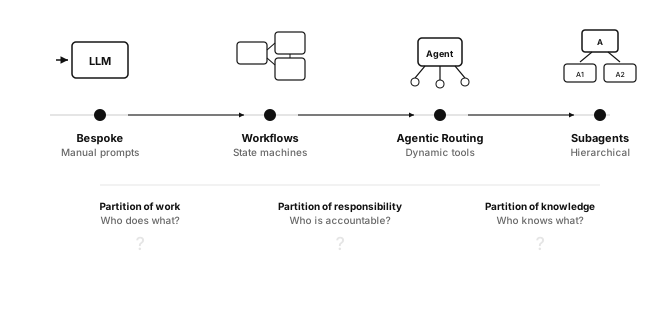
The evolution of agentic capabilities has progressed alongside model improvements [3][8][9][10]:
- Bespoke tasks with LLMs → Handcrafted prompts with manual routing
- Workflows with state machines → Deterministic transitions between states
- Agentic routing → Dynamic decision-making with tools
- Subagent delegation → Hierarchical task decomposition
Crucially, these levels are not a strict progression where each supersedes the last—they coexist. A production system will typically contain all four: bespoke prompts for well-understood subtasks, state-machine workflows where determinism is needed, agentic routing for flexible decision-making, and subagent delegation for complex decomposition. In my own work, all of these coexist to form reliable, cost-effective, and flexible systems. The right level depends on the task and domain, not on the system's overall sophistication. A useful heuristic: the lower on this curve a task sits, the more that context stuffing and simple tool design dominate; the higher, the more that deliberate context engineering and structural harnesses become necessary.
Practical Example — All Four Levels in One System
A system I built at kuona.ai illustrates how all four levels coexist within a single task execution. The system is a general business agent that, among other capabilities, can delegate data transformation work to a specialized subagent.
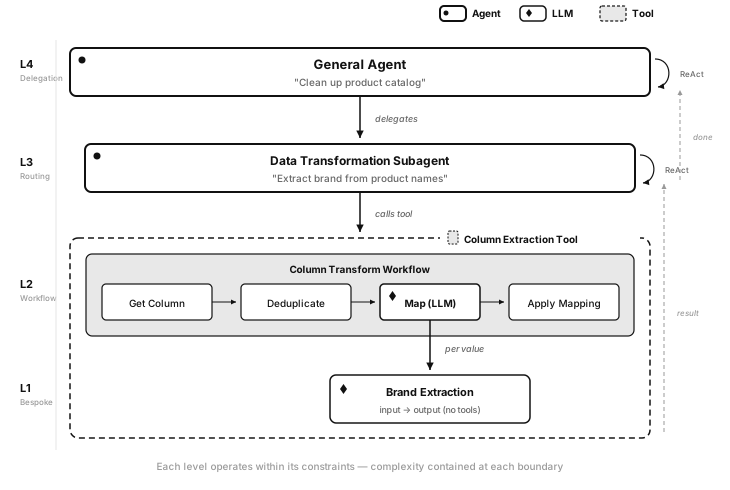
A user asks the general agent to clean up a product catalog. The agent determines that a column of free-text product names needs to be transformed into standardized brand categories. Here is what happens:
Level 4 — Subagent delegation. The general agent delegates the transformation task to a specialized data transformation subagent, passing a structured instruction: "Extract the brand from these product names."
Level 3 — Agentic routing. The data transformation subagent operates in a ReAct loop. It dynamically selects which tool to call based on the instruction—in this case, a column transformation workflow that works on a Table (a structured class, see Section 3.3) and targets a specific column.
Level 2 — Workflow with deterministic transitions. The column transformation tool is itself a workflow—a state machine that orchestrates a fixed sequence of operations: (1) obtain the column values, (2) deduplicate to extract unique values, (3) run a map operation over the unique values using an LLM, (4) apply the resulting mapping to the entire column to produce a derived column.
Level 1 — Bespoke LLM prompt. Inside the map operation, a purpose-built prompt receives each unique product name and extracts the brand. This is a single-purpose, well-scoped LLM call with no tool access and no agentic behavior—just input → output.
The workflow completes, producing a new "brand" column. Control returns to the ReAct agent, which may perform additional transformations. When the subagent finishes, control returns to the general agent, which continues with the next business task.
Note what happened: a single user request traversed all four levels of the evolution curve. The bespoke prompt didn't need tools. The workflow didn't need agentic routing. The ReAct agent didn't need to understand the workflow's internals. And the general agent didn't need to know how brand extraction works. Each level operates within its appropriate constraints, and the hierarchical structure ensures that complexity is contained at each boundary.
This progression reveals three fundamental questions that any agentic system must answer:
- Partition of work: Who does what work?
- Partition of responsibilities: Who is accountable for what outcomes?
- Partition of knowledge: Who knows what context?
Counterpoints & Discussion
The "small, composable tools" thesis is not without criticism. Research suggests that tool overload—having too many fine-grained tools—can increase decision friction and hurt selection accuracy [68][69]. LlamaIndex (2024) notes that fine-grained decomposition creates an increased burden on less-capable models [70]. The UNIX "do one thing well" metaphor may not map cleanly to model tool selection, where the cost of choosing between many similar tools can outweigh the benefits of composability.
2. Core Principles
Structure, in this framework, is any pre-computed organization that reduces the space an agent must navigate — whether designed by humans, derived automatically from previous usage, or produced through optimization. It is the opposite of "let the model figure it out from scratch." Structure takes many forms:
- Domain structure — Encoding the problem domain: schemas, entity relationships, business rules, valid states. The domain has inherent structure; the harness captures it rather than asking the model to rediscover it.
- Cognitive structure — Human-aligned reasoning patterns: decomposition, planning, step-by-step processes, hierarchical thinking. Structure that mirrors how humans organize complex work.
- State structure — Typed, addressable representations rather than raw text. Tasks, contexts, plans, action history as first-class objects with lifecycle—not strings in a conversation. This is central to the framework: unified state is the substrate on which all other structure operates.
- Constraint structure — Boundaries that reduce the action space: output schemas, tool interfaces, validation rules, privilege boundaries. The walls that keep the agent on track.
- Compositional structure — How work is partitioned across agents, delegation boundaries, hierarchy. The organizational chart of the system.
- Information structure — How context is organized, layered, and disclosed. What the agent knows, when it knows it, and in what format.
A clarification on what structure is not. By "structure" this paper does not mean the old-style prescription of rigid multi-agent workflows — "build subagent A for extraction, subagent B for validation, subagent C for formatting, connected by a fixed DAG." Any practitioner who has built agents at scale reaches the same conclusion: more flexibility, more shared context, and fewer hard boundaries produce the most general and frictionless designs. Cognition AI's argument against multi-agent architectures [50] captures an intuition widely held in the field — that parallelism boundaries and context isolation often create more friction than they resolve. But the conclusion should not be "therefore, remove all structure." Agents that are both reliable and fast can shed the old rigid context boundaries while introducing more precise structures — structures that enable better orchestration, lower latency, and capabilities that exceed the cognitive ceiling of the base model alone. Parallelism is an incredibly useful concept within agentic systems, and context boundaries are powerful — as long as they can be gracefully bypassed when the task demands it. The structure advocated here is as much about progressive disclosure as it is about alignment: the agent can always explore beyond what is initially provided, but certain task boundaries, tool constraints, and information layers are simply smart design. They don't cage the agent — they give it a head start. Structure also enables amortization and distillation: once a capable model has solved a class of tasks within a structured harness, the same structure — tool schemas, validation rules, forced tool patterns — can be reused to let cheaper, faster models operate those subsystems reliably. The structure compensates for the less capable model's limitations, turning what was once a frontier-model task into a routine operation. This is how production systems scale economically: the expensive model explores and establishes patterns; the structure captures those patterns; cheaper models execute within them.
Most of these principles are individually well-established—constraint satisfaction, external validation, progressive disclosure, and hierarchical decomposition appear across the existing literature on agent design [3][9][90]. The contribution of this section is not the individual principles but their organization into a dependency chain: each principle follows logically from the previous, and the chain as a whole provides a framework for reasoning about when and why to invest in structure, not just what structure to apply.
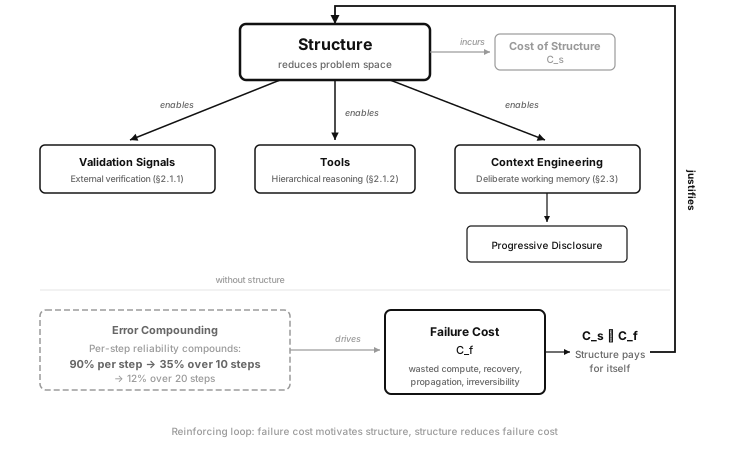
2.1 Structure Reduces Problem Space
This is the foundational principle from which most others follow. Constraints:
- Enable validation signals (checkable boundaries)
- Reduce problem spaces (fewer paths to explore)
- Improve computational economy (less work per step) [14]
- Prevent error propagation between tasks (isolation)
- Enable effective delegation (clear boundaries for splitting work across agents—see Section 3.7 for the full treatment)
External Validation Signals
Once a system is structured, its boundaries become checkable—which is what enables external validation.
Examples:
- Code linting and compilation
- Rule-tracking systems
- Formal plan verification [19]
- World-model validation
- External test suites
Why this matters: Validation signals allow agents to course-correct [20]. Crucially, these constraints should stem from mechanisms OUTSIDE the agent to form genuine boundaries.
Counterpoints & Discussion
Recent work challenges the strict necessity of external validation. Kumar et al. [21] achieve significant gains on MATH benchmarks through self-correction via reinforcement learning without external feedback. Intrinsic self-critique methods [73] have achieved strong results on planning benchmarks without external verifiers. However, the consensus remains that external feedback is more reliable for production systems [17][18].
Tools Enable Hierarchical Reasoning
Structure, concretely applied, takes the form of tools—pre-built abstractions that encapsulate solved problems [22][23].
Principle: Delegate reasoning to higher-level abstractions through tools.
Even when a model could solve a task without tools, well-designed tools provide:
- Hierarchical reasoning → No need to redo solved problems
- Predictable outputs → Pre-validated, well-understood behavior
- Battle-tested reliability → Hardened by previous use cases
Counterpoints & Discussion
Tam et al. [15] show that strict format constraints can degrade model reasoning performance—models forced into rigid output schemas sometimes sacrifice accuracy. Park et al. [16] demonstrate that grammar-constrained decoding distorts probability distributions. Banerjee et al. [71] propose alternating constrained and unconstrained generation as a middle path. More broadly, the Bitter Lesson argument [72] suggests that hand-crafted structure will eventually be superseded by scaling compute and data.
Practical Example — Hierarchical Reasoning Done Right: Entity Semantics Search
At kuona.ai, agents need to search across user catalogs, ontologies, and domain-specific entities — product hierarchies, promotional categories, store groupings — to answer business questions. A naive approach would have the agent reason over raw catalog data at query time, parsing thousands of entries to find semantically relevant entities. This is exactly the kind of solved problem that tools should encapsulate.
Instead, we built a decoupled semantic indexing system: an asynchronous agent that pre-processes user catalogs and ontologies into task-specific semantic databases. This agent runs offline, building structured indexes that capture entity relationships, synonyms, hierarchical groupings, and domain semantics. The main agent never sees the raw catalog data — it calls a search tool that queries these pre-indexed structures.
The search tool itself calls a workflow underneath — an agentic search over the semantic databases — but from the main agent's perspective, it is a single tool call: "find entities matching this concept." The hard reasoning (understanding what "premium beverages" means across a retailer's specific product taxonomy) has been solved offline and baked into the index. The main agent reasons at a higher level: which entities to search for, how to combine results, and how to use them in downstream queries.
Why this works as hierarchical reasoning: The semantic indexing agent solves entity understanding once. The search tool encapsulates that solution. The main agent delegates a narrow, well-defined task — semantic entity lookup — to a pre-built abstraction, and gets back structured, validated results. Without this tool, the agent would need to reason over raw data on every query, multiplying both latency and error surface. With it, the agent operates on pre-solved semantic understanding, focusing its reasoning capacity on the actual business question rather than on entity resolution.
Practical Example — When Tools Are Missing: The LIDA Visualization Trap
An earlier kuona.ai system attempted autonomous visualization generation inspired by Microsoft Research's LIDA [96]. The initial vision was full autonomy: a user asks a question, the system produces a correct visualization without human involvement, using model-driven code generation to produce arbitrary plots.
The system worked end-to-end, but it was unreliable. Models generated syntactically valid plotting code that made poor visualization choices — mishandling outliers, selecting inappropriate chart types, producing unreadable scales. The initial assumption was that better prompts or larger models would fix these surface-level issues. That assumption was wrong. The problem was architectural: arbitrary code generation for visualizations required visual reasoning that language models fundamentally lacked. No amount of prompt engineering could bridge that gap.
The fix was to introduce tools. Instead of generating free-form plotting code (reasoning from scratch every time), the system was redesigned around a curated set of visualization templates with well-defined configurations. The agent's role shifted from "generate anything" to "route and parameterize the right visualization." These templates were the missing hierarchical abstraction — pre-built tools that encapsulated solved visualization problems (how to handle outliers, how to scale axes, how to label series).
What was lost: fine-grained control over custom plots, the ability to add arbitrary annotations, and any visualization outside the template library. What was gained: accuracy went from ~70% to ~95%, failures became predictable, and every visualization followed consistent design principles — a unified output language that emerged precisely because the scope was constrained. A second tradeoff followed: rather than adding retry loops to chase the last 5%, the interface was redesigned to give users direct control when a visualization was flagged as low quality. What felt like admitting defeat on the autonomous vision became the feature users valued most — predictable reliability with escape hatches.
The lesson for hierarchical reasoning: The original system asked the agent to reason from first principles about visual design on every invocation. The fix was to package that reasoning into tools — constrained, validated, battle-tested abstractions. The agent stopped solving visualization problems and started selecting pre-solved solutions. Reliability came not from improving the model's raw capabilities, but from redefining the task boundary so the agent reasoned at the right level of abstraction.
Structure also carries implicit alignment—a point developed fully in Section 3.12.
2.2 The Cost of Unconstrained Systems
The existing literature is clear on what structure to apply but largely silent on when the investment is justified. Anthropic advises "find the simplest solution possible" [3]; OpenAI recommends "an incremental approach" [9]. These are useful heuristics but not decision frameworks. This section proposes a formal cost model for reasoning about the structure investment—arguably the most distinctive contribution of this paper.
What happens when you ignore structure? A fully unconstrained agent (no structure, no verification, no premade tools, no limitations) might solve a problem, but at what cost? To reason about this clearly, it helps to think in terms of two competing cost functions.
The Two Cost Functions
Every agentic system implicitly makes a tradeoff between two costs:
Cost of Structure (C_s): The upfront and ongoing investment in constraints.
- Design cost → Engineering time to define tools, schemas, validation rules
- Maintenance cost → Keeping structure updated as requirements evolve
- Flexibility cost → Tasks that don't fit the structure require workarounds
- Runtime overhead → Validation checks, schema enforcement, plan verification
Cost of Failure (C_f): The expected cost when things go wrong.
- Direct cost → Wasted tokens, API calls, compute on failed paths
- Recovery cost → Replanning, rollback, state repair, human intervention
- Propagation cost → Downstream errors caused by upstream failures
- Irreversibility cost → Actions that cannot be undone (emails sent, data deleted, state corrupted)
Structure is economically justified when the reduction in expected failure cost exceeds the cost of imposing it: C_s < ΔC_f × P(failure). This is the economic argument for why structure motivates the rest of this paper.
Error Compounding in Multi-Step Tasks
The most powerful argument for structure is probabilistic. In a multi-step task, per-step reliability compounds multiplicatively:
| Per-step success rate | 5 steps | 10 steps | 20 steps |
|---|---|---|---|
| 90% (no structure) | 59% | 35% | 12% |
| 95% (light structure) | 77% | 60% | 36% |
| 99% (heavy structure) | 95% | 90% | 82% |
A 5-percentage-point improvement in per-step reliability (90% → 95%) nearly doubles the success rate over 10 steps. This is why structure matters most for long-horizon tasks—even small reliability gains at each step have dramatic compound effects.
Corollary: The longer the task horizon, the more structure is justified, because the compounding penalty for per-step unreliability grows exponentially. This also connects to the redundancy principle (Section 2.5, Redundancy): having multiple paths to success at each step is one mechanism for increasing per-step reliability.
The Validation Cost Asymmetry
A key economic property of agentic systems: validation is almost always cheaper than inference.
| Operation | Token cost | Latency | Reliability |
|---|---|---|---|
| Compiler check | 0 tokens | ~ms | Deterministic |
| Linter/formatter | 0 tokens | ~ms | Deterministic |
| Test suite | 0 tokens | ~seconds | Deterministic |
| Schema validation | 0 tokens | ~ms | Deterministic |
| Model self-assessment | 100s–1000s tokens | ~seconds | Probabilistic |
| Model re-reasoning | 1000s+ tokens | ~seconds | Probabilistic |
When external validation is available, it dominates self-assessment on every dimension: cheaper, faster, and more reliable. This asymmetry is what makes the external validation principle (Section 2.1, External Validation) not just theoretically sound but economically compelling—delegating verification to purpose-built external mechanisms is almost always the right trade.
When Structure Doesn't Pay
Structure is not always justified. The cost model identifies conditions where flexibility wins:
- One-off tasks → C_s cannot be amortized across multiple executions
- High novelty → The task space is too unpredictable to constrain usefully
- Cheap failure → C_f is low (reversible actions, no downstream consequences, low token cost)
- Rapidly evolving domains → Maintenance cost of structure exceeds its benefits
This connects directly to the Flexibility-Reliability Tradeoff (Section 2.4): the maturity curve is really a curve of amortized structure cost declining as task frequency and predictability increase.
Counterpoints & Discussion
The compounding reliability argument assumes step independence—that per-step success rates are uncorrelated. In practice, failures often cluster: a single misunderstanding early in a task can cascade into correlated failures across all subsequent steps, making the effective compounding worse than the independent model predicts. Conversely, agents that self-correct can exhibit positive correlation where early successes build context that improves later steps. The simple multiplicative model is useful as a mental framework but may over- or underestimate actual failure rates depending on the domain.
Practical Example — What You Optimize For Changes Everything
The cost model above is deliberately abstract — C_s and C_f are expressed in generic "cost" without specifying what that cost measures. This is intentional: the dominant cost dimension varies across systems, and the structural decisions that follow from the model change accordingly. The framework is a general heuristic; the instantiation is domain-specific.
When latency is the cost function. At kuona.ai, latency is one of the north-star metrics — particularly for certain tasks and subagents in the interactive query pipeline, where the system serves business analysts who ask questions and expect answers in seconds, not minutes. (Correctness is an even higher priority — see below — but for the latency-sensitive surfaces, speed dominates the structural decisions.) In this regime, C_f is measured primarily in time: a failed step triggers a retry loop, each retry adds seconds of model inference, and users abandon queries that take too long. Structure is justified when it eliminates retry cycles — a validation check that takes 5ms and prevents a 3-second retry loop is an obvious win. This shaped every architectural decision: pre-computed semantic indexes (Section 2.1, Tools) exist because entity resolution at query time added unacceptable latency, visualization templates replaced code generation because retrying failed plots was too slow, and context was structured by change rate (Section 3.2) because KV cache reuse cut per-turn inference time. The cost model didn't say "add structure everywhere" — it said "add structure wherever it eliminates a latency-visible failure mode."
When inference cost is the cost function. A different system — a batch processing pipeline that runs overnight, classifying and routing thousands of documents — operates under a completely different C. Latency is irrelevant; the pipeline has hours. But every token costs money, and at scale, wasted tokens dominate the budget. Here, C_f is measured in dollars: a failed classification triggers a re-inference on a document that might be 50k tokens, and propagation cost means a misclassification early in the pipeline causes expensive downstream reprocessing. Structure is justified when it prevents token waste — a lightweight classifier that routes documents to specialized prompts (cheaper, shorter) instead of feeding everything to a single expensive prompt, or a schema validator that catches malformed output before it propagates to the next stage. Retry loops are acceptable (time is cheap); token-burning retry loops are not.
When correctness is the cost function. At kuona.ai, after the query system retrieves data, a separate system answers user questions grounded on those results. In this regime, C_f is measured in business risk: a single hallucination or misread data point in an answer can drive decisions worth millions of dollars, and the error may take months to surface. A business analyst who trusts an AI-generated insight about promotional effectiveness, inventory allocation, or pricing strategy acts on it immediately — and by the time the mistake is discovered, the downstream damage is already done. This is why the system was built around a strict grounding architecture: every claim in a user-facing answer must trace back to retrieved data, every numerical assertion is cross-validated against the query results, and the system refuses to speculate beyond what the data supports. Correctness in the answer-crafting layer is the north-star metric — not latency, not token cost, but whether the answer faithfully represents the underlying data. The cost model says "C_s is almost always less than C_f" because C_f is catastrophic and delayed. The "When Structure Doesn't Pay" conditions rarely apply — even one-off analyses need grounding structure because cheap failure doesn't exist when the wrong number can redirect a client's strategy.
C can vary within the same system. At kuona.ai, the query system is multi-tenant across different database backends. When the agent queries cloud data warehouses and big data infrastructure, failures are expensive: queries take seconds to minutes, consume compute resources, and a malformed query against a production warehouse can time out, lock resources, or return misleading partial results. In this regime, strict query planning and validation paid for themselves immediately — a planning layer that validated query structure, checked schema compatibility, and verified join paths before execution prevented costly round-trips to remote infrastructure. But the same system also handles small datasets that fit in the agent's local environment via DuckDB. Here, the entire cost calculus flips: queries execute in milliseconds against an in-process database, failures are instantly visible and instantly retryable, and there are no remote resources to waste. Errors are cheap. For DuckDB queries, the planning layer was dropped entirely — the agent generates and executes queries directly, iterating on failures at negligible cost. The same system, the same agent, two completely different structural decisions — because C_f for a failed cloud warehouse query and C_f for a failed DuckDB query differ by orders of magnitude.
The general heuristic: Before applying the cost model, identify what your system's C actually measures. The same architectural decision — adding a validation checkpoint, pre-computing an index, constraining output format — can be clearly justified, clearly wasteful, or somewhere in between, depending entirely on which cost dimension dominates. The model is universal; the parameterization is not.
The conditions above—when structure pays and when it doesn't—are not binary. They form a spectrum, which the following section formalizes.
2.3 Context Engineering
Structure tells you what's relevant and what isn't—which leads to the operational principle of deliberately managing what enters the context window.
The field has converged on the term context engineering [30] to describe this practice, with substantial recent treatment by Anthropic [90], Martin [94], and others. The discipline encompasses designing the full informational environment an agent operates within—not just what's in the prompt, but what's retrieved, when it's loaded, how it's structured, and what's excluded. Context engineering subsumes prompt engineering the same way software architecture subsumes writing functions. The principles below are well-established in this literature; our contribution is connecting them to the dependency chain—showing how context engineering follows from structure (Section 2.1) and operationalizes the cost model (Section 2.2).
Principle: The context window is the agent's working memory. Structure it deliberately [25][26][27][28].
This is where the structure principle (Section 2.1) becomes operational. Structure tells you what information is relevant for a given task, which boundaries separate concerns, and which contexts belong to which agents. Without structure, context engineering degenerates into guesswork—stuffing tokens and hoping the model finds what it needs.
What context engineering controls:
- Selection → What information enters the context window (and what doesn't)
- Ordering → How information is sequenced (recency, relevance, dependency)
- Representation → How information is formatted (raw text, summaries, structured schemas)
- Timing → When information is loaded (upfront, on-demand, forced)
Research consistently shows that context quality matters more than context quantity. Irrelevant context actively degrades performance [26], length alone hurts even with perfect retrieval [27], and models exhibit predictable attention patterns that structured context can exploit [25].
Progressive Disclosure
The primary mechanism for effective context engineering: don't load everything upfront—reveal information incrementally as needed [31][32].
Principle: Reveal information incrementally as needed.
This prevents context overload while maintaining access to necessary information. The parallel to cognitive science is striking: Miller's "Magical Number Seven" [33] and Baddeley's working memory model [34] both suggest that human cognition benefits from bounded information flow. Packer et al. [35] explore analogous memory management for LLMs in MemGPT.
Progressive disclosure is not the same as minimizing context. Sometimes the right context engineering decision is to load more—context stuffing remains highly effective when the corpus fits and is relevant. Progressive disclosure is the general pattern; context stuffing is the trivial special case where everything fits and everything is relevant.
Practical Example — From Context Stuffing to Progressive Disclosure
The same kuona.ai system from Section 1.2 illustrates how context strategies evolve—not because of context window limits, but because of compositional demands. The system is an NLP-to-SQL agent that performs promotional postmortem analysis: a user asks a business question, and the agent translates it into SQL queries against the company's data warehouse.
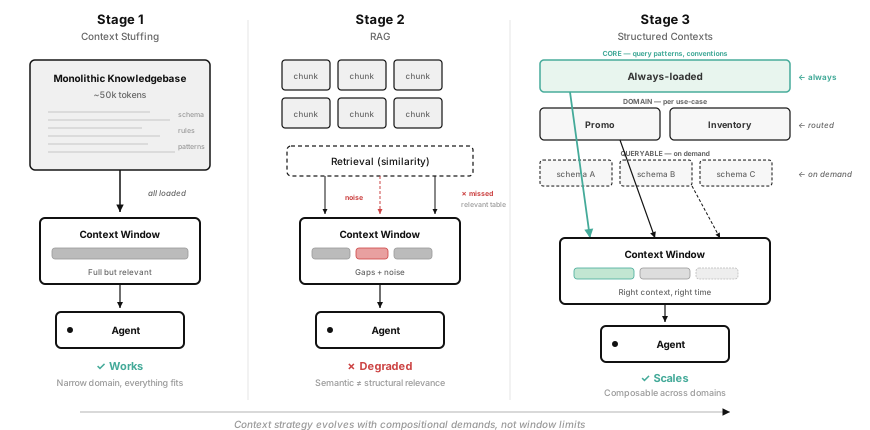
Stage 1: Context stuffing (worked well). The initial version used a single ~50k token knowledgebase file that mixed domain knowledge (schema definitions, business rules, metric calculations) with task knowledge (query patterns, SQL dialect conventions, common joins). Context stuffing worked because the domain was narrow and bounded—promotional analysis only. The corpus fit, everything was relevant. This is the trivial special case.
Stage 2: RAG (degraded performance). When exploring optimization, RAG was tried. It introduced latency, sometimes missed relevant tables or columns (low recall), and sometimes injected semi-relevant but confusing context (noise). Maximizing recall recovered performance and achieved some savings over stuffing everything, but the fundamental issue remained: the retrieval mechanism couldn't distinguish what was structurally relevant from what was semantically similar. A table's schema definition might not be semantically close to the user's question, but it's structurally essential for writing a correct query.
Stage 3: Structured contexts (enabled scaling). Scaling from promotional analysis to general business use cases forced the real solution. The monolithic knowledgebase got split into structured contexts with different treatment:
- Always-loaded context: Core DB query patterns and system conventions—how queries must be built, SQL dialect rules, output formatting. Loaded on every invocation.
- Domain contexts: Per-domain knowledge (promotional metrics vs. inventory vs. finance)—loaded based on task routing, so the agent gets the right business framing for its current task.
- Queryable context: Domain-specific schema details—retrieved on demand when the agent needs to inspect a table's structure or understand a column's semantics.
This is progressive disclosure in practice: the agent always has the foundation, gets the domain framing for its current task, and can reach for details as needed.
The evolution from stuffing to structure wasn't driven by context window limits. The 50k tokens still fit. It was driven by the need for composability—the same agent serving multiple domains required the context to be engineered, not just loaded.
Counterpoints & Discussion
Long-context models consistently outperform RAG in average performance when sufficient compute is available [29]. Databricks (2024) shows that corpora under 2M tokens can be fed directly without retrieval. This suggests that aggressive context minimization is often counterproductive—more context, properly structured, yields better results than aggressive filtering. The real skill is knowing what to include, not how little you can get away with.
2.4 The Flexibility-Reliability Tradeoff
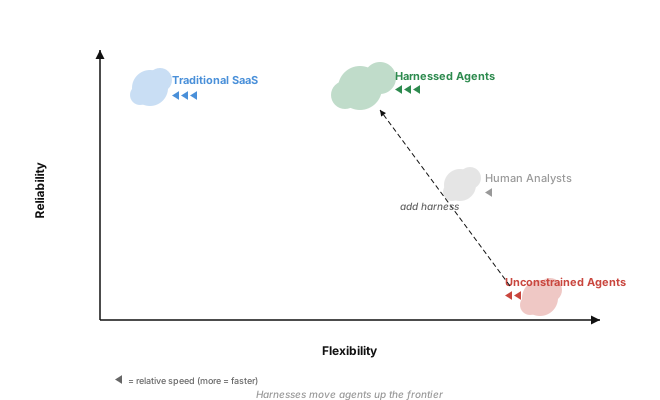
Any process an agent works on exists on a maturity curve [3][36][37]:
- One-off tasks → Require flexibility and exploration
- Mature processes → Benefit from rigidity, predictability, and structure
While some agents work well as completely flexible, reliability and low latency come from structure. Agents built with these structural harnesses—structured agents—occupy the upper-right of this space: high flexibility through model reasoning, high reliability through external constraints.
Even with increased agentic capabilities, reducing the problem space and "degrees of freedom" leads to reduced latencies and improved reliability. The structured agency approach is fundamentally about moving agents upward on this chart by adding harnesses rather than restricting what they can do.
Designing for Harness Obsolescence
The flexibility-reliability tradeoff has a temporal dimension that is central to how structured agency should be practiced: build harnesses expecting them to weaken over time.
The Bitter Lesson has been applied directly to agent scaffolding by Martin [93], Bowne-Anderson [95], and others, with the practical observation that agent harnesses must be "repeatedly simplified as models improve"—that teams at Anthropic and elsewhere rebuild their agent infrastructure on the order of months, not years. We agree with this framing and formalize it as a design principle: harness obsolescence is not a failure of design but a feature of well-designed systems.
Current harnesses address current model limitations. State management compensates for the fact that models lack persistent memory across invocations. Context-window-as-working-memory harnesses (progressive disclosure, forced contexts, retrieval mechanisms) exist because attention doesn't scale perfectly and context is expensive. Structured output schemas exist because models don't always produce well-formed output. Validation signals exist because models can't yet reliably self-verify. Each of these is a response to a specific limitation—and each limitation is on a trajectory of improvement.
As models improve, some harnesses will naturally weaken. A model with perfect self-verification needs fewer external validation signals. A model with reliable structured output needs less schema enforcement. A model with effectively infinite context and perfect attention needs less aggressive progressive disclosure. New architectures may overcome the need for external memory entirely, collapsing the state management harness into the model itself. The Bitter Lesson predicts exactly this trajectory: capabilities that were once impossible without external scaffolding get absorbed into the model itself.
But even as harnesses weaken, domain-specific structured state remains economical. The latency cost of having a model re-derive a customer's order history from raw conversation logs—every invocation—will always exceed the cost of maintaining that information in a structured state object, regardless of how capable the model becomes. The cognitive cost (in tokens) of navigating an unstructured environment will always exceed the cost of navigating one where the structure is pre-computed. This is the same argument that applies to software engineering generally: we don't rewrite parsers from first principles every time we need to parse JSON, even though we could. Structured agency's harnesses occupy this same economic niche—they are amortized investments in structure that pay dividends across invocations. The right design principle, then, is not "build permanent harnesses" but "build harnesses with a clear understanding of which limitations they address and how those limitations are evolving." This is the temporal dimension of the flexibility-reliability tradeoff: the optimal point on the curve shifts over time as model capabilities advance, and well-designed structured agents shift with it.
Commoditizing Intelligence
Section 2.4, Harness Obsolescence argues that the harness should survive model improvement—the temporal axis. There is a second axis: the harness should survive model substitution.
Principle: Treat the model as a replaceable commodity. The harness is the stable layer; the intelligence provider is a variable.
The economic realities of model serving make this more than an architectural nicety. Providers compete on price, latency, and capability across different task profiles. A model that is cost-optimal for structured extraction may not be the best choice for open-ended reasoning. A harness that abstracts over the intelligence provider can route tasks to the appropriate model—or simply to the cheapest one that meets the reliability threshold. This is the same economic logic that drives cloud infrastructure: you don't build your application around a specific EC2 instance.
This connects directly to the cost model (Section 2.2): different models align with different cost functions. A task where C_f is measured in risk — the grounded answer system from Section 2.2 — justifies routing to the most capable (and expensive) model, because the cost of a hallucination dwarfs the inference premium. A task where C_f is measured in latency — entity resolution at query time — favors the fastest model that meets the accuracy threshold, even if a more capable model would be marginally better. A task where C_f is measured in dollars — high-volume classification or routing — favors the cheapest model that clears the reliability bar. Model commoditization is not just about substitution resilience; it is about matching intelligence cost to task risk. The harness that treats models as interchangeable also enables the harness that routes each task to the model whose cost profile best fits its C.
The robustness argument is equally compelling. Provider outages, rate limits, and deprecations are operational realities. A harness designed around model interchangeability treats these as transient conditions rather than architectural crises—if one provider fails, the system falls back without adaptation.
This principle extends down to the implementation level. Frameworks like PydanticAI, LangChain, and similar orchestration layers earn their value not primarily through abstraction but through the operational niceties that make model commoditization practical:
- Retry loops with exponential backoff for transient provider errors (rate limits, timeouts, 5xx responses)
- Structured output validation with automatic retries — when the model produces malformed JSON given a schema constraint, the framework re-prompts rather than failing. This is a harness that compensates for a model limitation (unreliable structured output), exactly as Section 2.4, Harness Obsolescence describes.
- Provider-agnostic interfaces that allow swapping the underlying model without changing application code
- Streaming, token counting, and cost tracking as cross-cutting concerns independent of which model is being called
Importantly, benefiting from these niceties does not require buying into any framework's full ecosystem or opinionated agent architecture. The retry loops, structured output validation, and provider abstraction are composable building blocks—you can use them to construct your own harnesses without adopting the framework's opinions about how agents should be structured. The value is in the operational primitives, not the orchestration philosophy.
These primitives are themselves harnesses in the structured agency sense. They sit between your application logic and the intelligence provider, adding structure (retries, validation, provider abstraction) that makes the system more reliable. The model produces the intelligence; the harness ensures that intelligence is delivered reliably, affordably, and in the right format.
Counterpoints & Discussion
Model-agnostic design can paper over meaningful capability differences. Not all models handle tool calling, structured output, or multi-turn reasoning equally—abstracting over these differences can lead to lowest-common-denominator designs that fail to exploit what a specific model does well. Some architectures (like Claude's extended thinking or OpenAI's o-series reasoning) offer unique capabilities that a generic interface cannot expose.
2.5 Robustness
Two principles address how systems become more resilient over time: redundancy provides immediate fault tolerance, while shared stress hardens components through diverse usage.
Redundancy is a Feature
Rationale: From a probabilistic argument, having multiple paths to success increases the likelihood of task completion. Relying on a single tool (unless it's ubiquitous) creates fragile systems.
Examples:
- Multiple retrieval mechanisms (grep, semantic search, full-text search)
- Multiple communication channels
- Fallback tools when primary tools fail
Stress Strengthens a System
Principle: Reuse agents and components across contexts. Shared stress surfaces harden them.
Rationale: A component used in one context is fragile — its edge cases are discovered only within that context. A component reused across many contexts is stressed from multiple directions, forcing it to become more general, more robust, and more predictable. Stress — the pressure of diverse usage patterns — strengthens a system the same way load testing strengthens infrastructure.
Practical Example — From Monolithic Agents to Reusable Cores
At kuona.ai, an early discovery shaped the entire architecture: designing monolithic agents with all desired capabilities baked in led to brittle code. When agent B needed a capability that lived inside agent A, the result was either duplication (rewriting the capability) or tight coupling (calling into agent A's internals). Both paths created fragility — a change to agent A's prompts or tool configuration would silently break agent B's dependency.
The solution was to structure from the beginning so that the same agents and the same prompts would be reused across as many contexts as possible. A single query agent, with the same core prompt and tool set, serves promotional analysis, inventory questions, and financial reporting. Each new domain that stresses the agent exposes edge cases that, once fixed, benefit every other domain. The agent got stronger as it was reused — more general, fewer blind spots, more predictable failure modes.
A subtlety in how this was achieved: the alternative to reuse is decomposition — splitting capabilities into separate specialized modules. For instance, SQL generation could live in a dedicated subagent that the main agent delegates to. But this creates a more brittle system with more dependencies: the main agent must know when to delegate, the subagent must understand the main agent's context, and the interface between them becomes a failure surface. Instead, the main agent was designed to be reconfigurable — its tool set and directives can be narrowed per invocation. When only SQL generation is needed, the agent is invoked with the SQL tool forced and a directive to return after generating the query. Same agent, same prompt, same battle-tested reasoning — just a narrower scope. This is reuse through reconfiguration, not decomposition through delegation.
These lessons — that reuse hardens components, that monoliths are brittle, and that reconfiguration beats decomposition — heavily influence the formalisms in the taxonomy that follows. The distinction between invocation-level configuration (Section 3.2) and agent identity, the treatment of tools as state that can be added or removed per invocation (Section 3.3), and the composition patterns (Section 3.7) all trace back to this practical discovery.
2.6 The Agent-Harness Relationship
Beyond robustness, two principles address how agents relate to the structure around them: harness awareness treats structure as capability rather than constraint, while permeable boundaries ensure that structure does not become rigidity.
The Agent Should Know Its Harness
Principle: Design the harness so the agent can introspect it, reason about it, and use it to amplify its own capabilities — not merely be constrained by it.
Rationale: The default framing of structure is restrictive — guardrails, constraints, boundaries, limitations. This framing is incomplete. A well-designed harness is not a cage; it is an exoskeleton. The agent that is aware of its tools, its context boundaries, its validation signals, and its delegation paths can reason about them as resources, not just obey them as rules. The shift is from structure-as-restriction to structure-as-capability.
An agent that knows it has a schema validator can proactively check its own output before submitting it. An agent that knows its context is structured by change rate can decide what to offload and what to keep. An agent that knows it can delegate to a scoped subagent can choose delegation strategically rather than having it imposed. An agent that knows its working memory has been compacted can recognize when it is operating on incomplete information and reach for addressable history. In each case, the harness becomes something the agent uses, not something that uses the agent.
Design implications:
- Make structure visible — Tool descriptions, available contexts, delegation capabilities, and validation mechanisms should be legible in the agent's working memory. The agent should know what it has access to, not discover it by accident.
- Make structure introspectable — The agent should be able to query its own harness: what tools are available, what contexts are loaded, what constraints are active, what has been compacted. Introspection turns the harness from an external imposition into an internal resource.
- Design for leverage, not just compliance — When adding a structural element, ask not just "does this prevent the agent from failing?" but "does this enable the agent to succeed in ways it couldn't without it?" The best harnesses do both.
This principle connects back to the clarification at the opening of this section: structure is not the old-style rigid workflow that constrains the agent into a fixed path. It is the set of capabilities, boundaries, and information architecture that the agent can leverage to reason better, act faster, and recover from errors more gracefully. The agent that understands its own harness is more capable than the unstructured agent — not less flexible, but more powerful.
Security caveat: A capable-enough agent that can fully introspect its harness could also reason about how to circumvent its safety limitations. This means the harness must combine introspectable structure with non-negotiable boundaries: read-only, non-modifiable constraints that the agent can observe but not alter, and implicit guardrails — limited-access credentials, sandboxed execution environments, scoped permissions — that enforce safety regardless of what the agent reasons about them. Harness awareness amplifies capability, but the safety-critical parts of the harness must remain outside the agent's ability to modify. See Section 3.12 for how structured harnesses can be applied creatively to security.
Permeable Boundaries
Principle: Focus by default, but make context boundaries permeable — the agent should be able to reach beyond its initial scope when needed.
Rationale: When composing agents (Section 3.7), the natural instinct is to isolate — give the subagent only what it needs and wall off the rest. This is half right. Focus is essential for cognitive economy: a narrower tool set, a scoped state schema, and a targeted bootstrap all reduce the reasoning burden per turn. But hard boundaries — where the subagent simply cannot access parent state, contexts, or tools — rest on a specific risk calculus: that the parent will delegate the right task, that the subagent's initial state contains everything needed to solve it, and that the agent will find the correct reasoning path within its scoped context. Failure on any one of these assumptions yields either confidently incorrect outcomes or, in more sophisticated systems with inter-agent communication, escalation overhead introduced by an improper subagent/task boundary.
I propose a design principle: boundaries should be soft by default. The subagent's bootstrap loads what it's expected to need. Its tool set is scoped to the task. But the broader parent state remains accessible — through state-facing tools, through shared structure classes (Section 3.3), through communication channels back to the parent (Section 3.5). The subagent can reach for more context if it needs it. It just doesn't start with everything loaded.
This is progressive disclosure (Section 2.3) applied to composition: the subagent starts focused, but the full context is behind a reachable boundary, not a wall. The common case is optimized — focused context means better reasoning, less distraction, lower token cost. But the edge case is survivable — unexpected needs can be self-served rather than causing failure cascades.
The payoff is asymmetric: better performance in the common case (focused context = better reasoning) without catastrophic failure in the edge case (unexpected needs can be self-served). Hard walls offer marginally better isolation in the common case but dramatically worse outcomes when assumptions break. Soft boundaries sacrifice almost nothing in the common case while preserving recoverability.
This connects back to Harness Awareness: the subagent should know that broader context is available. If it knows it can query the parent's task list, search the parent's contexts, or request additional tools, it can decide autonomously when to reach beyond its initial scope. An agent that doesn't know the boundary is permeable will never try to cross it — and will fail silently when its initial scope proves insufficient.
2.7 Build for the Future
Principle: Design harnesses for the ceiling, not the floor. Today's models are the worst they will ever be [102][103] — invest in higher-potential designs now, even at a latency cost, because speed will catch up from multiple independent directions.
Section 2.4 establishes that harnesses should be designed for obsolescence — expect them to weaken as model capabilities improve. This companion principle addresses the forward-looking investment question: when choosing between a simpler approach with a lower ceiling and a more ambitious approach that is slower today, prefer the higher ceiling.
The argument rests on an empirical observation that has held consistently since 2020: each generation of models is substantially more capable, substantially cheaper, and substantially faster than the last. Altman characterizes this as "the cost to use a given level of AI falls about 10x every 12 months" [104] — a compounding rate that dwarfs Moore's Law. The practical consequence for agent builders is that a design bottlenecked by inference latency today will not be bottlenecked for long. A harness that trades latency for correctness — by routing through a more capable model, by adding validation loops, by using richer context — is making a bet that will pay off as the latency cost falls toward zero.
Three independent vectors are compressing inference latency simultaneously:
- Smaller models closing the capability gap. Tasks that require a frontier model today will be achievable by smaller, faster models within months. The capability waterfall is well-documented: what required GPT-4 at launch is now achievable with models a fraction of the size. Harnesses designed for capable reasoning — not optimized for the cheapest model that barely works — will benefit automatically as the capable tier gets faster and cheaper.
- New architectures breaking the sequential bottleneck. Autoregressive generation is inherently sequential — one token at a time, each depending on all previous tokens. Discrete diffusion language models [105][106] replace this with parallel denoising: the model generates a rough sketch of the entire output, then iteratively refines many tokens simultaneously. Inception Labs' Mercury achieves throughputs of 1,000+ tokens per second on reasoning tasks — an order of magnitude faster than comparable autoregressive models — by exploiting this architectural shift. As diffusion-based and other non-autoregressive architectures mature, the latency floor for generation drops dramatically, and the bottleneck shifts from inference speed to the quality of the harness around it.
- Specialized inference hardware replacing general-purpose GPUs. Groq's Language Processing Unit [107] uses deterministic scheduling and massive on-chip SRAM to eliminate the memory bandwidth bottleneck that constrains GPU inference, achieving hundreds to thousands of tokens per second on large models. Cerebras' Wafer-Scale Engine [108] takes the approach to its physical extreme: a single chip the size of an entire silicon wafer, with 44 GB of on-chip SRAM and 21 PB/s of memory bandwidth. SambaNova's Reconfigurable Dataflow Units [112] take a different angle — dataflow architecture that reconfigures itself per model layer, achieving high throughput on large models while maintaining flexibility across architectures. Taalas' HC1 [109] goes further still — hardwiring model weights directly into silicon as an application-specific circuit, achieving 17,000 tokens per second for Llama 3.1 8B by eliminating the weight-loading step entirely. As these hardware approaches mature and reach wider deployment, inference latency drops by another order of magnitude independent of any model improvement.
The convergence of these three vectors creates a strong asymmetry: investing in correctness and capability pays compound returns; optimizing for today's latency constraints pays diminishing ones. A harness built around multi-step validation, rich context loading, and capable reasoning will get faster for free as models shrink, architectures parallelize, and hardware specializes. A harness built around minimizing model calls — skipping validation, using shallow context, routing to the cheapest model — locks in a lower ceiling that no amount of infrastructure improvement can raise.
This does not mean ignoring latency. Latency matters for user experience and operational cost. The principle is about architectural decisions at design time: when two designs offer different ceilings, choose the higher ceiling and trust that the floor will rise. Bustamante [110] observes that scaffolding built to compensate for model limitations — PDF converters, compute engines, complex retrieval pipelines — is routinely absorbed by the next model generation. Some of this scaffolding becomes cruft that anchors the agent to operate in a suboptimal way, working around limitations that no longer exist. But not all scaffolding is compensatory. Validators, schema checks, and structural constraints provide useful signals about correctness regardless of model capability; even when seldom triggered, they serve as guardrails worth preserving. The harnesses that survive are those that encode genuine domain structure rather than patch transient model weaknesses.
The practical heuristic: if you are choosing between "fast but brittle" and "correct but slow," choose correct. Speed is a problem that three independent industries are solving simultaneously. Correctness is your problem alone.
With the principles established, we now turn to how they manifest concretely in agent design. The taxonomy below maps each principle to the architectural surfaces where harnesses can be applied.
3. Taxonomy of Structured Agents
The structured agency framework decomposes agents into a set of concerns—each representing a surface where harnesses can be applied. This taxonomy describes those surfaces.
The following iconography is used consistently across all diagrams in this paper:


3.1 World
World — Everything external to the agent system: files, APIs, databases, users, other services, and the physical or digital environment the agent operates in.
The world is not designed by the agent builder — it is given. It changes independently, does not conform to rules the agent can enforce, and is the source of all nondeterminism the agent must handle.
Defining the world matters because it defines the boundary between world and state. State is the region the agent system controls — where it can impose structure, enforce invariants, and guarantee properties. The world is everything outside that boundary. The framework splits the two so that we can bound a region of order and nice properties: validated schemas, consistent structure classes, observable mutation. Consider a database agent: the production database is world — other services write to it, schemas may change, rows appear and disappear. The agent's internal representation of that database — cached schemas, query results, known table relationships — is state. Or a coding agent: the broader development environment (CI systems, remote repositories, other developers' changes) is world; the local filesystem the agent has access to is its state.
The boundary is not always clean. A coding agent's filesystem is both state (it controls it) and world (another process could modify it concurrently). A database agent's cached schema is state until the real schema changes underneath it — or, if the agent has exclusive access, the database itself becomes effectively state. In practice, the boundary is a design choice: the agent builder decides what falls inside the structured, governed region and what remains external and unpredictable. The value of making this choice explicit is that it clarifies what the system can guarantee and what it must treat as uncertain.
3.2 Agent
Agent — A reasoning core that observes the world through actions and builds an internal state representation.
The agent is what reasons. It receives a snapshot of its state as input, decides what to do, and expresses that decision as tool calls or output. Between decisions, it does not exist as a running process — the harness is what persists. The agent's power comes not from what it stores (it stores nothing) but from what it can attend to (working memory) and what it can do (tools). Everything else — persistence, validation, scheduling, recovery — belongs to the harness and state.
In current systems, the agent is typically a foundation model — an LLM, a vision-language model, or increasingly a vision-language-action model (VLA). This is an implementation detail, not a definitional requirement — but it is a consequential one. These models are stateless, opaque, and probabilistic. These properties shape every design decision in the framework: state must be externalized because the agent retains nothing; validation must be external because the agent's reasoning cannot be inspected; and structure must compensate for variance because the agent's output is nondeterministic.
Invocation
Invocation — The period from when an agent "starts up" until it "dies" and stops performing actions.
An agent may persist across multiple invocations with the same state. Each invocation provides two things: the initial state and the agent. That is all. In practice, this means things like allowed tools, initial context, and directives — but these are examples, not rules. The invocation boundary defines what is given, not a fixed schema of what must be given.
Implementation note: Whether each user input triggers a new invocation (daemon shuts down) or the agent persists across inputs is an implementation detail. The key is distinguishing between invocations and mere instruction reception.
Practical Example — Decoupled Invocations at Kuona
At kuona.ai, we pre-emptively launch agent invocations when leading indicators suggest the agent will be needed—effectively a warm start. The agent is already running when the user message arrives, so it hits the ground running. Earlier versions tied invocation lifetime to user message reception, but decoupling them yielded cleaner semantics:
- Warm starts become natural. The invocation exists before any user input; the first message is just another event.
- Lifecycle is decoupled from message reception. The agent's birth and death are governed by orchestration policy, not by whether a chat message happened to arrive.
- Double-dialing and multiple messages are handled by design. Because message reception is a simple operation within an already-running agent—rather than the trigger that creates it—concurrent or duplicate messages require no special-case handling.
This pattern also enables long-running agent designs where user messages and inter-agent messages flow through the same pathways. We exploit this in Kuona's testing harness, which simulates user trajectories and replays them against production agents—the agent cannot distinguish a synthetic test message from a real user message, because structurally they are identical.
Critically, the agent runtime does not exist between invocations. Once an invocation ends, the process shuts down — there is no idle daemon consuming resources. State is persisted externally, and the next invocation reconstructs everything it needs from that state. This is a deliberate trade-off: zero idle cost, at the expense of cold-start latency (mitigated by the pre-emptive warm-start strategy above).
Practical Example — Persistent Daemon in OpenClaw
OpenClaw takes the opposite approach. Its agent runs as a persistent daemon — a long-lived Node.js process that stays alive between invocations, maintaining WebSocket connections to messaging platforms and keeping session state hot in memory.
Where a decoupled model optimizes for resource efficiency (no idle cost, pay only for active computation), the persistent daemon model optimizes for responsiveness and proactive behavior. The persistent runtime enables:
- Zero cold starts. The agent process is always running; incoming messages hit an already-warm runtime with session context loaded.
- Heartbeat-driven proactive behavior. A configurable heartbeat (defaulting to 30 minutes) triggers agent turns even without user input — the agent can initiate actions, check on long-running tasks, or send unprompted updates. This is only possible because the runtime persists between invocations.
- Persistent connections. WebSocket connections to external platforms stay open, avoiding the overhead of reconnecting per invocation.
The invocation concept still applies: each agent turn is a discrete cycle of context assembly, model call, and tool execution. But the process that hosts those invocations is long-lived. Session state is persisted to disk (append-only JSONL transcripts), and a lane-aware queue ensures only one invocation runs per session at a time — solving the concurrency problem that idle time between invocations would otherwise introduce.
Interruptions as a lifecycle property: Invocations can be interrupted—by the user, by the parent agent, by budget exhaustion, or by a sibling's failure. An invocation that is interrupted mid-execution must leave state in a recoverable condition. This means state must be designed to survive interruption: partial writes should be atomic or rollback-safe, and in-progress markers should be distinguishable from completed ones. Interruption is not an edge case—it is a first-class lifecycle event that the agent model must account for. See Section 3.10 for how interruptions propagate through hierarchical systems.
Model
Model — The foundation model that powers the agent's reasoning. The model is stateless: it has no memory between calls. All persistence is through working memory and state.
For most current "agentic" systems, the agent is a foundation model — an LLM, a vision-language model, or a vision-language-action model (VLA). The model is the implementation of the "reasoning core" in the agent definition above — the component that, given an observation of the world (working memory), decides what to do next (tool calls or terminal output).
Statelessness is the fundamental property. Between turns, the model retains nothing. No hidden state carries over, no internal "memory" persists. All continuity comes from working memory being re-presented at the start of the next turn. This is why context engineering (Section 2.3) matters so much — the only lever for shaping the agent's reasoning is shaping what it sees.
The model is a black box from the harness's perspective. The harness cannot inspect or modify the model's internal reasoning — it can only shape what goes in (context engineering) and constrain what comes out (validation, tool design). This asymmetry is why structure matters: you cannot fix reasoning directly, but you can make correct behavior the path of least resistance through well-designed tools and directives.
Model selection is a design decision. Different invocations, subagents, or tasks can use different models. This connects directly to the cost functions in Section 2.2: risk-sensitive tasks warrant more capable models, latency-sensitive tasks warrant faster models, and cost-sensitive batch tasks warrant cheaper models. A well-structured harness makes model selection a configuration parameter, not an architectural commitment.
The model's capabilities — context window size, tool-calling fidelity, reasoning depth — constrain what the agent can accomplish per turn. This is precisely why structure compensates for model limitations: a model that struggles with complex multi-step reasoning in a single pass can succeed when the harness decomposes the problem into simpler per-turn decisions.
Turn
Turn — A single model call cycle: the agent receives its working memory as input, generates output (text and/or tool calls), tool calls are executed, results are appended to working memory, and the next turn begins. The turn is the atomic unit of agent computation.
The agent loop can be expressed as: while not done: turn(working_memory) → output → execute tools → update working_memory. Each turn transforms working memory through the model's reasoning — the model reads everything in the context window, decides on actions, and the harness executes those actions and appends results for the next turn.
Between turns, the agent does not exist as a process. No computation runs. The harness is what operates at turn boundaries: validating outputs, injecting context, synchronizing state, checking budgets, and deciding whether to continue or terminate the invocation. This is the harness's primary control surface.
This creates a three-tier mutation model: during a model turn, nothing modifies state — the model is reasoning, not acting. Between turns within an invocation, only tool results modify state, making atomic operations straightforward to enforce at the harness level. Outside an invocation, state can be modified for operational needs (migrations, administrative updates, inter-agent coordination). This layered constraint is what makes the agent's state reasoning tractable: during any given turn, the agent knows that the state it observes is exactly the state that existed after its last tool execution.
Each turn can produce multiple tool calls (parallel tool use) or no tool calls (terminal output that ends the invocation). A turn is the atomic transition within a bounded execution.
Budget is measured in turns. Turn count is a natural unit for bounding invocation cost — each turn represents a model call with measurable token consumption and latency. Token budgets accumulate across turns. This is where the cost functions from Section 2.2 are operationalized: the harness enforces budget constraints at turn boundaries, terminating the invocation when limits are exceeded.
The harness's control surface operates entirely at the turn boundary. Between any two turns, it can: inject context into working memory, force specific tool use, validate or reject the previous turn's output, modify available tools, or terminate the invocation. The agent never "sees" this intervention — it simply receives a new working memory state at the start of the next turn.
Directives
Directives — The goals, constraints, and rules that guide the agent's behavior. These include system prompts, task descriptions, and behavioral guardrails. Directives shape what the agent does and how it does it.
We use "directives" rather than "system prompt" because the term fits better within the agent language. In language model implementations, directives are system prompts — but we avoid calling them "prompts" to distinguish them from other sources of instruction. A user message can contain prompts. A skill can inject prompts. A forced tool result can carry prompt-like content. Directives are the subset of prompts that are bound to the invocation — they are set when the invocation is configured and remain stable across turns. Other prompts arrive dynamically and are part of working memory, not directives.
Directives and working memory together determine the agent's behavior at any point in an invocation. Where working memory defines what the agent can see, directives define what the agent should do with what it sees.
Working Memory
Working Memory — What the agent can currently attend to. Working memory is populated by tool results, directive content, and prior conversation. It is finite and transient — information not actively maintained is effectively forgotten.
In language models, working memory is realized as the context window — a fixed-size stream of tokens [33][34][35][45]. The context window is an implementation constraint, not a conceptual primitive.
Best practice: Treat the context window as a scratchpad, not permanent storage:
- Don't depend on it for long-term memory
- Successive invocations should preserve only relevant information (through pruning or compression)
- Supplement with forced tool use and external contexts
Caveat: The scratchpad metaphor has limits. Language models are causal models — each token's representation depends only on the tokens before it, and inference engines exploit this through KV caches and prompt caching. When the prefix of the context window is unchanged across requests, its key-value representations can be reused, dramatically reducing cost and latency. Treating working memory as a freely mutable scratchpad — inserting, reordering, or modifying content near the top — invalidates these caches and forces full recomputation. This creates a practical design constraint: structure context by change rate. Place invariant content (system prompts, tool definitions, stable directives) at the beginning, semi-stable content (loaded contexts, retrieved documents) in the middle, and volatile content (recent conversation turns, tool results) at the end. This layering — invariant → semi-stable → volatile — maximizes cache reuse while preserving the scratchpad's flexibility where it matters most.
Critical distinction: The context window is NOT the agent's state — it is the agent's view of its state. Working memory is populated by tools that load, search, and surface relevant state into the context window. The quality of that population — what gets loaded, when, and in what form — is context engineering (Section 2.3).
Taxonomy of working memory content. Working memory content is organized by how it enters working memory — the mechanism, not the content type. Everything except directives is mediated by tool calls, and this observation collapses the taxonomy to three categories:
- Directives — The only content not mediated by tool calls. Goals, constraints, behavioral rules, and tool definitions set at invocation configuration (Section 3.1). Directives occupy the stable prefix of the context window, are invariant across turns, and benefit most from KV cache reuse.
- Bootstrap results — Content loaded by bootstrapped tool calls at invocation start: initial state (domain data, task context, configuration), dynamically loaded tool definitions, and — critically — summaries of the current task and past work on it. Bootstrap results are how the harness constructs the agent's initial orientation from durable state rather than carried-forward conversation. Everything here is fully reconstructable: it can be re-read from state, making it safe to evict and reload.
- Turn content — Everything produced during the agent loop: model output (text, reasoning, decisions), tool results (from both agent-initiated and forced tool calls), and harness injections (temporal guidance, validation signals, staleness warnings). This is the only category that accumulates — every turn appends to it — and the primary target of compaction and context management. Turn content is also the primary source of context rot: old reasoning traces, stale tool results, and superseded constraints compete for attention with the current task.
Compaction vs. bootstrap as dual strategies. These two mechanisms represent complementary approaches to context management with a fundamental asymmetry between them. Compaction decides what stays within working memory — it requires acute awareness of what is already present, what matters, and what can be dropped. Bootstrap decides what enters working memory — relevance decisions can be made during bootstrapping, and even before, based on the current task and available state. Compaction operates on an existing context it must understand; bootstrap operates on structured state it can query. This is why bootstrap is the more tractable problem and why the framework favors reducing dependency on compaction in favor of structured reconstruction.
Bootstrap (Section 3.2.1) constructs initial working memory from directives and bootstrap results — categories 1 and 2. Turn content — category 3 — is where dependency accumulates and where compaction or offloading to Contexts is most needed. The design goal is to minimize how much turn content must survive across turns: decisions and constraints should be offloaded to state as Contexts, where they become addressable bootstrap results in the next invocation rather than fragile conversation history that must survive compaction.
Working Memory Management — Context Rot, Compaction, and the Limits of Summarization
Long-running invocations inevitably exhaust the context window. When the agent must transition between tasks or shed old interactions to make room for new ones, the question becomes: what to keep, what to compress, and what to discard.
Context Rot
This is not merely a space management problem. Context rot [97] — the empirically demonstrated degradation in model performance as context length increases — means that accumulated content actively harms the agent before the window is even full. Research across 18 models shows that accuracy declines consistently with input length, that irrelevant-but-similar content (distractors) amplifies degradation disproportionately, and that information buried in the middle of the context is recalled far less reliably than content at the beginning or end [98]. Stale tool results, old reasoning traces, and superseded constraints don't just waste tokens — they dilute the model's attention budget and degrade its performance on the current task. This makes working memory management not an optimization but a correctness concern: an agent that retains too much irrelevant context will perform worse than one that strategically forgets.
Lossy Summarization
The common approach is lossy summarization: when transitioning between tasks, generate a compressed summary of past interactions and continue with the new task on a fresh context. This works in the narrow sense — the agent retains a high-level understanding of what happened — but it introduces problems that go beyond simple forgetting. Summarization loses the specific constraints, edge cases, and corrections that accumulated during the prior task. When the agent later re-encounters a related situation, it must re-acquire that context from scratch — a context re-acquisition cost that can exceed the original interaction. Worse, lossy compression runs counter to the prompt caching systems discussed above: rewriting the context prefix invalidates the KV cache, so every compaction triggers a full recomputation of the surviving content. Summarization trades token count for cache efficiency — often a bad trade.
Structured Compaction
Structured compaction offers a better model. Rather than summarizing everything uniformly, exploit the structure of the conversation itself. Claude Code's context compaction, for instance, performs summarization but retains some addressability of previous interactions — before summarizing, it uses the structure of messages to selectively drop previous tool results, intermediate reasoning, and other high-volume low-retention content, while preserving the decisions, constraints, and corrections that are likely to matter later. This is closer to what this framework proposes with Contexts (Section 3.6): working memory content that has been used should be offloaded to addressable, retrievable state rather than compressed into a lossy summary. The agent can then re-acquire specific context on demand rather than carrying everything or losing everything.
Epistemological Humility
The deeper challenge is epistemological. A compacted agent doesn't know what it has forgotten. Without some form of introspection into past interactions — even a structured index of what was discussed, decided, and constrained — the agent cannot know when it is operating on incomplete information. The ideal is epistemological humility baked into the system: the agent should have awareness of the boundaries of its current working memory, know that prior interactions existed beyond what it currently sees, and have tools to reach back into them when needed. If the system provides structured introspection into past interactions within the limits of working memory — a table of contents of what was compacted, what decisions were made, what constraints were established — the agent can adapt: it can recognize when a current task touches on prior context and selectively re-acquire what it needs.
An Open Problem
While bootstrap offers a structured alternative to compaction for fresh invocations, the problem of managing working memory within a long-running invocation remains open. Current systems either summarize too aggressively (losing critical detail) or retain too much (exhausting the context window and accelerating context rot). The structured agency approach suggests a middle path: treat compacted history as a Context — addressable, searchable, and selectively loadable — rather than as a string to be summarized or discarded. The Contexts primitive introduced in Section 3.6 maps cleanly to the concept of external memory in recursive language models — state that lives outside the agent's immediate observation but can be accessed through deliberate action. Minimizing dependency on the context window beyond a certain saturation point will likely be crucial for reliable long-horizon agents, but the design to do this properly remains unclear. The natural approach — recursive decomposition into subagents with scoped contexts — runs into latency costs that quickly exceed acceptable thresholds for interactive systems. Each delegation boundary adds round-trip overhead, and deeply nested decompositions multiply that cost. The tension between context rot (too much in one window) and delegation latency (too many windows) is one of the central unsolved design problems in agentic systems.
Bootstrap
Bootstrap offers a fundamentally different approach to managing working memory across invocation boundaries: rather than compacting an existing context, it reconstructs working memory from scratch. This sidesteps compaction's fundamental problem — that lossy summarization requires awareness of what exists in working memory and what matters — by rebuilding from structured state. The term "bootstrap" is deliberate: it generates the minimal context needed for an agent to understand its role, orient itself within state, and receive harness instructions.
The bootstrap stage constructs the initial working memory through directives and forced tool usage. Specifically, it informs the agent of: (A) the existence of a state, including its structure classes and their schemas; (B) the set of bootstrap tools with their purpose and minimal usage examples (e.g., a tool to read contexts, a tool to search for tools beyond the bootstrap set); (C) depending on token budget, additional tools beyond the bootstrap set; and (D) the output of any bootstrap forced tool calls — reading certain contexts, querying task state, loading domain data. The result is a working memory that contains everything the agent needs to begin acting, assembled from durable state rather than carried forward from a prior conversation.
The principle underlying bootstrap is that the shorter-term the agent's dependency on the context window, the better. Every piece of information that must survive across many turns in working memory is a liability — subject to context rot, lost in compaction, competing for attention. If goals, decisions, and constraints are tracked in state as Contexts, bootstrap can reliably reconstruct the agent's orientation by loading those Contexts — converting long-term working memory dependency into short-term reconstruction from state. This shifts design overhead from compaction to state structure, which is a deliberate trade: state structure is explicit, inspectable, and testable, while compaction quality is opaque and model-dependent.
Bootstrap as an alternative to compaction. Prompt compaction — summarizing or truncating the context window to stay within token limits — is the dominant strategy in current agent systems for managing long-running conversations. But compaction is inherently lossy: a model summarizing its own context must decide what matters before discarding what doesn't, and that judgment is opaque, model-dependent, and irreversible. Bootstrap offers a structurally different approach. Rather than compressing existing working memory, it discards it entirely and reconstructs from state. This has several advantages. First, stable prefix efficiency: a well-designed bootstrap reconstructs the stable parts of working memory first (role, tools, schemas) and the variable parts second (current task state, recent results), producing a context with the kind of coherent structure that compaction destroys. Second, phased summarization: because state is persistent and tool-mediated, the agent can write intermediate result summaries to state during execution — not as a desperate compression step when the context window fills, but as a deliberate practice that keeps state current. These summaries are then immediately available whenever bootstrap is next triggered, turning what would be a lossy emergency operation into a structured, incremental one. Third, rediscovery over retention: compaction forces the agent to retain a compressed understanding of everything it might need; bootstrap allows the agent to rediscover specific structured state on demand. It is better to re-read a well-structured task result from state than to rely on a compacted summary of it that lives only in working memory — the former is lossless and addressable, the latter is degraded and opaque. Both compaction and bootstrap are lossy in principle, but bootstrap's losses are bounded by state design (which is explicit and testable), while compaction's losses are bounded by model summarization quality (which is neither). An agent that follows the principles in this paper — structured state, addressable contexts, progressive disclosure — can use bootstrap to go beyond what compaction alone can achieve.
3.3 State
State — The totality of an agent's structured understanding of the world. State is all — domain data, configuration, memories, and critically, tools themselves.
Key properties:
- Tool-mediated mutation. All state changes go through tools — the fundamental structural contract. Because tools write their results to working memory, every state mutation is immediately visible to the agent: it knows what changed because it saw the tool result. Because tools are introspectable by the harness, every mutation can be audited, validated, and constrained. And because tool use can be forced, the harness can ensure critical state synchronization happens regardless of the agent's initiative. If state could change through side channels — background processes, silent updates, external mutations not surfaced through tools — the agent would be reasoning about a world it cannot observe, and the harness would lose its ability to enforce invariants.
- Persistence. State survives where working memory does not. Between invocations, working memory is discarded and reconstructed; state endures. This is what makes bootstrap possible (Section 3.2.1): the harness reconstructs working memory from state, converting long-term dependency on the context window into dependency on structured, durable storage.
- Typed structure. State is schematized, not free-form text. Structure classes (below) give state a shape that supports validation, addressability, and programmatic access. This is what distinguishes structured agency from prompt engineering: the agent's world has known types, enforced invariants, and consistent operations — not strings that happen to contain useful information.
- Reflexivity. Tools are themselves state. The agent's capability surface — which actions it can take, with what parameters, under what constraints — is not fixed at design time but exists as inspectable, discoverable, and in some cases mutable state. This is elaborated in Tools as State (below); the implication is that the boundary between "what the agent knows" and "what the agent can do" is itself part of the structured world the agent operates on.
State design requirements. The properties above describe what state is; the following describe what state should be from the agent's perspective — requirements that guide how state is structured and accessed:
- Introspectable — The agent must be able to observe its own state. Without introspection, the agent cannot reason about what it knows, what has changed, or what it needs. (See "Introspection without intervention" below.)
- An extension of the agent's memory — State is structured, persistent memory that compensates for working memory's limits. Where working memory is finite and transient, state is the durable, organized extension. By design, state reduces the agent's dependency on the context window — information that lives in state does not need to persist in working memory.
- Selectively editable — Not all state is writable; some encodes domain constraints as read-only. The asymmetry between readable and writable state is itself a structural guarantee. (See "Introspection without intervention" below.)
- Tool-mediated — All interactions go through tools, which are themselves state. Tools are the agent's interface to state, and state is the agent's interface to the world — this circular relationship (tools → state → world → state → tools) is the mechanism that makes reducing context window dependency possible: the agent accesses state lazily through tools rather than needing it all in working memory.
- Persistent — State survives invocation boundaries. This is what makes state an alternative to working memory rather than just another view of it.
- Addressable — State entities can be referenced by name, ID, or query. State that isn't addressable can't be selectively loaded into working memory, directly undermining the goal of reducing context window dependency. This connects to the principle of building tools that operate on specific entities rather than bulk state.
- Inter-agent shareable — State can be partially or fully shared across agents. This is the substrate for composition (Section 3.7) — without shareable state, multi-agent coordination reduces to message-passing without shared ground truth.
Why structure state? The benefits are operational, not abstract:
- Validation at the boundary. Structured state carries its own invariants. A tool that creates a task can enforce required fields, valid transitions, and referential integrity at creation time — validation moves from the prompt (unreliable, model-dependent) to the type system (reliable, deterministic). This is why structure classes (below) define lifecycle properties including creation, mutation, and validation rules: the constraints live in the state definition, not in the instructions.
- Cognitive economy. State-facing tools let the agent offload information from working memory to state and retrieve it on demand, reducing the cognitive load of any single turn. The agent doesn't need to carry everything in attention; it needs to know where to look. This is the mechanism behind the "shorter-term dependency on the context window" principle: information that lives in addressable state does not need to persist in working memory.
- Composability. Structured state is the substrate for multi-agent coordination (Section 3.7). When state has known types and consistent access patterns, agents can share, inspect, and build on each other's work without parsing free-form text. An agent that reads another agent's task output gets typed data with validated structure, not a string to be interpreted.
- Observability. Because all mutations go through tools and all state is typed, the system has a complete, structured record of what changed, when, and through what action. This is the foundation for the observability layer (Section 3.11) — without structured state, audit trails are string logs rather than queryable data.
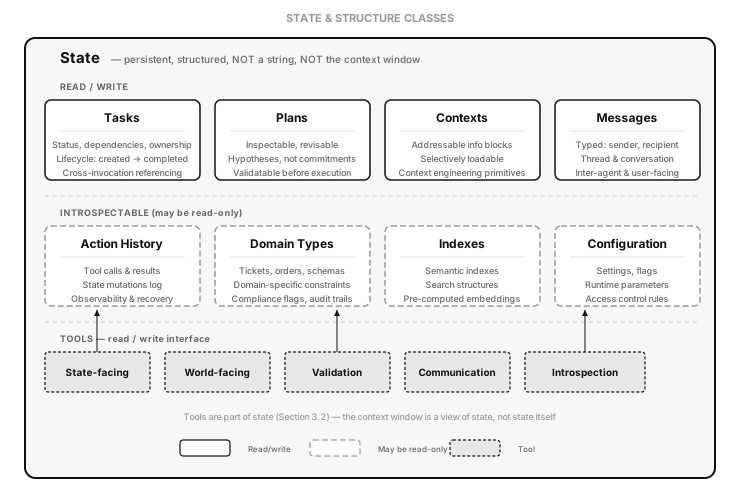
Structure Classes
The principle that state is typed and schematized raises a natural question: what is state made of? Structure classes are the first-class types that populate structured state—the building blocks that make state genuinely structured rather than an opaque blob. The collection of structure classes that constitutes an agent's state is its state schema — the shape of the agent's world, defined by which types exist in it and how they relate.
The term "class" here is formal but not necessarily object-oriented. A structure class may be a literal class in an OOP language — a Task with typed fields, validation methods, and state transitions. But it may equally be a category of state that happens to have consistent structure: a filesystem is a structure class even though no one wrote a Filesystem class definition. What matters is that instances of the class share a common schema (files have names, paths, contents, permissions), support consistent operations (read, write, move, delete), and can be validated against known invariants (paths must be unique, permissions must be valid). Whether that structure is enforced by a type system, a database schema, an operating system, or a convention is an implementation detail. The concept is the same: a named category of state with known shape and rules.
Core structure classes:
- Tools — The agent's action interface, elevated to a first-class state type. Tools live in state, can be introspected, and in coding agents can be modified (see Tools as State below). Listed here because tools are not external to the agent's state — they are state that the agent acts through.
- Contexts — Addressable information blocks that agents can load, search, and reference — the building blocks of context engineering (Section 2.3). Listed here because they are a state type: they exist in state, are updated through actions, and have lifecycle properties. See Section 3.6 for the full treatment.
- Messaging Channels — Structured records of inter-agent and user-agent communication. Not just log entries but typed objects with sender, recipient, content, timestamp, and thread/conversation metadata. Channels are the substrate for composition (Section 3.7) — without structured messaging, multi-agent coordination reduces to string passing.
- Plans — Structured plan representations that live in state. A plan is itself a state object that can be inspected, validated, and revised (see Section 3.9).
- Action History — Structured log of actions taken and their outcomes. Each entry records the tool called, its arguments, its result, and any state mutations it caused. This is the basis for observability (Section 3.11) and recovery (Section 3.10).
Extended structure classes — not required for every agent, but valuable when the problem demands them:
- Tasks — An encapsulation of work. Having tasks as a first-class structure class — not strings in a plan but structured objects with status, dependencies, ownership, and outcome descriptions — enables referencing work across invocations of the same agent, tracking the work of other agents, deferring or scheduling asynchronous work, and integrating tasks that arise from external systems. This is analogous to task primitives in orchestration frameworks (Celery, Temporal, Airflow), elevated to a core concept of agent state. Tasks carry lifecycle metadata (created, assigned, in-progress, blocked, completed, failed) that enables the planning (Section 3.9) and composition (Section 3.7) layers to operate on them programmatically. Section 3.8 develops the full treatment of tasks as the unit of computation across tool calls, subagent invocations, and the root agent itself.
A well-designed task structure separates three concerns: the task itself holds lifecycle metadata and a brief outcome description; the result (the actual artifact or data produced) exists as separate state that the task references but does not contain; and the execution log (what was done, intermediate steps) is a Context associated with the task, not embedded in it. This decomposition maximizes component reusability — results can be consumed by other tasks or agents without parsing task objects, and execution logs can be loaded selectively via progressive disclosure rather than inflating every task read. - Subagents — Child agents spawned by a parent, represented as structured state with their own invocation lifecycle, budget, tool access, and results. Making subagents a structure class — rather than opaque function calls — enables the parent to inspect progress, redirect work, and recover from child failures. See Section 3.7 for composition patterns.
- Skills — Reusable, composable capability bundles that package directives, tool configurations, and context together. A skill is a structured recipe that can be invoked, parameterized, and combined — enabling agents to acquire new capabilities without modifying their core architecture.
Domain-specific types — The types that encode the actual problem domain: tickets, orders, code files, database schemas, customer records. These are what make a structured agent domain-aware rather than domain-agnostic.
Introspection without intervention. Structure classes can always be introspected—the agent can read tasks, query plans, search contexts—but they are not necessarily modifiable. A structure class may be read-only: the agent can observe it but cannot change it. This asymmetry is not a limitation; it is a feature. Read-only structure classes encode domain-level constraints—invariants that the harness enforces by making certain state unwritable. A customer record's compliance flags, an order's immutable audit trail, a plan's locked dependencies—these are state the agent must respect but cannot alter. The constraint lives in the access pattern, not in the prompt. This is structure (Section 2.1) applied at the data level: by controlling which structure classes are writable, the harness bounds the agent's action space without the agent needing to understand why certain mutations are forbidden.
Lifecycle properties common to all structure classes. What makes something a structure class rather than an ad-hoc data blob is that it participates in a consistent lifecycle:
- Creation — Structure classes are instantiated through tools, never through free-form text generation. A task is created via
create_task(), not by the agent writing "TODO: do X" into a string. This ensures every instance has the required fields, valid types, and proper initial state. Creation is the first validation boundary. - Mutation — Changes to structure classes go through typed operations that enforce invariants. A task transitions from
pendingtoin_progressvia a state machine, not by overwriting a string field. Mutation operations can enforce preconditions (can't complete a task that's blocked), maintain referential integrity (completing a task unblocks its dependents), and record provenance (who changed what, when, and why). This connects directly to the state mutation constraint discussed in State Staleness below: during an invocation, only tool results mutate structure classes. - Validation — Structure classes carry their own validation rules. A plan with circular dependencies is invalid regardless of how confidently the agent generated it. Validation can be synchronous (reject malformed mutations immediately) or deferred (flag consistency violations for the agent to resolve). Either way, the validation lives in the structure class definition, not in the prompt — making it reliable across models, invocations, and agents. Validation rules should themselves be introspectable: an agent that can query what makes a structure class valid can self-correct before submitting invalid mutations, rather than discovering constraints only through rejection.
- Consistency — Because validation is enforced at creation and mutation boundaries, state should retain valid instances at all times. There is no window during which an invalid structure class instance exists in state — malformed creations are rejected, invalid mutations are refused. This is a stronger guarantee than eventual consistency: the state is always consistent, not merely convergent. This property simplifies every downstream consumer — the agent, other agents, the harness, observability systems — because none of them need to handle or recover from structurally invalid state.
- Serialization — Structure classes must survive the boundaries between turns, invocations, and agents. This means they have a canonical serialized form that preserves their typed structure — not a lossy string summary but a representation that can be deserialized back into a fully typed object.
State Staleness
State's role is not merely to store the agent's understanding of the world — it is to characterize the freshness of that understanding. Every piece of state is implicitly a measurement of the world at a particular time. By structuring world observations as typed, timestamped state objects, the system makes staleness legible — it can reason about when each observation was taken and whether it is likely to still be valid.
State represents the agent's structured understanding of the world — but the world keeps changing. A database schema queried ten minutes ago may have been altered. A task list fetched at the start of an invocation may have been updated by another agent or a user. An external API's response may have changed since the agent last called it. State can go stale, and stale state is a source of silent failures: the agent acts on a snapshot that no longer reflects reality.
The problem is compounded by a fundamental limitation: models are unreliable at temporal reasoning. A model cannot reliably determine whether one second or one week has passed since it last observed a piece of state. It has no internal clock, no sense of elapsed time, and no mechanism to reason about whether its cached knowledge is still valid. Left to its own devices, an agent will treat state fetched at the beginning of a long invocation as equally fresh throughout — even as the world diverges from its representation.
Staleness operates at three levels, each requiring different mitigation:
- World → State: The external world changes but the agent's state hasn't been updated to reflect it. A competitor's price changed, a customer submitted a new order, a deployment completed.
- State → Working Memory: The agent's state has been updated (perhaps by another agent or an external system), but the agent's working memory still holds the old values from when it last loaded them.
- World → Working Memory: Both state and working memory are stale — the agent is reasoning about a world that has moved on at every level.
A key design decision of this framework is that state can only be modified by tools during agent execution — not by external factors. This constraint dramatically simplifies the staleness landscape: by ensuring that no external process mutates state while the agent is running, State → Working Memory staleness is effectively eliminated during execution. The agent's working memory faithfully reflects state because the only mutations to state are the agent's own tool calls, whose results are immediately appended to working memory. The primary staleness concern becomes World → State — the external world diverging from the agent's structured representation — which is a fundamentally simpler problem to reason about and mitigate. (State → Working Memory staleness can still occur through prompt compression or other working memory management that drops or rewrites content the agent has already seen — compaction is the most common source. The less the agent depends on working memory content persisting across many turns, the less exposure to this class of staleness.)
Mitigation strategies:
Temporal guidance injection. The harness injects time-aware signals into the context window, compensating for the model's inability to track elapsed time. This can be as simple as a system-level annotation: "It has been 45 seconds since tasks were last checked. Task state may have been updated by other agents or users." The model doesn't need to reason about time — the harness does the temporal reasoning and translates it into natural language guidance that the model can act on. Timers, heartbeat signals, and staleness warnings are all forms of temporal guidance that the harness provides because the model cannot provide them for itself.
Forced periodic tool use. Rather than relying on the agent to decide when to re-check state, the harness forces synchronization at defined intervals or triggers. This is forced tool use (Section 3.4) applied to staleness. For instance, if the agent is working on a task that depends on incoming changes from another system, the harness can poll automatically by forcing a tool call before each agent turn. In practice, this pattern works well for incoming user messages: a hook before each agent turn forces
receive_messages(), and if any new messages are found, their content is present in working memory by the time the underlying model is invoked. The agent doesn't need to remember to check — the harness ensures it always has current information.Tool-level validation. Tools themselves can perform synchronization checks before acting on state, ensuring that the state they're about to modify still reflects reality. A tool that updates an order's status can first verify that the order hasn't been modified since the agent last read it — the same optimistic concurrency pattern used in database systems. If the state has drifted, the tool returns an introspective error ("Order #4521 was modified 12 seconds ago by another process. Current status is 'shipped', not 'processing' as expected. Re-read before proceeding.") rather than silently operating on stale data. This pushes staleness detection to the point of action, where it matters most.
State staleness is where the framework's commitment to external validation (Section 2.1, External Validation) becomes most concrete: the agent cannot reliably determine whether its own state is fresh, so the harness must provide the temporal awareness and synchronization mechanisms that the model lacks.
Tools as State
The agent model diagram places tools inside state, not alongside it. This is not a visual convenience — it is a conceptual claim: tools are a special case of state.
In LISP, code is data. In agent systems, tools are state that the agent acts through. They exist in the agent's state, can be introspected, and in coding agents, can be modified. This has several implications.
Two orientations of tools:
- World-facing tools (actions) — Reach outside state to observe or affect the external environment: `execute_sql`, `call_api`, `write_file`, `send_message`. These are the agent's hands.
- State-facing tools (cognitive economy) — Reach into state to introspect or modify the agent's own structured representation: `list_tables`, `get_schema`, `read_context`, `search_state`. These are the agent's capacity for self-reflection.
State-facing tools are what make progressive disclosure (Section 2.3, Progressive Disclosure) possible in practice. Rather than loading all state into working memory, the agent uses state-facing tools to discover what exists (`ls`), search for relevance (`grep`), and read the detail (`cat`). The progressive disclosure funnel is implemented through state-facing tools.
Tools can be introspected and modified: In coding agents, the toolset itself is editable state — an agent can inspect its available tools, understand their capabilities, and write new tools or modify existing ones. Non-coding agents don't necessarily have a way or reason to modify their tools — though nothing prevents it — but can still introspect them: reading tool descriptions, understanding parameters, discovering capabilities through progressive disclosure.
Bootstrapping requires state introspection: For an agent to begin operating on structured state, it must have tools to discover what that state contains. Without `list_tables` or `get_schema` or equivalent, the agent cannot learn what it has to work with. State-facing tools are the minimal bootstrap — they must be available from the first invocation. Some tools must be automatically invoked or their descriptions automatically loaded into the agent's directives or working memory. This is forced tool use (Section 3.4) — a bootstrapping mechanism that ensures the agent starts with the minimum context needed to act effectively. The Working Memory Management deep dive (Section 3.2) describes the full bootstrap process, of which state-facing tool availability is the foundational prerequisite.
Section 3.4 elaborates on tool design, categorization, and forced tool use patterns. The distinction here is conceptual: tools are not a separate concern from state but a structured interface within it.
Why Tools Are State
The claim that tools are state is the most counterintuitive assertion in this taxonomy. Most engineers think of tools as capabilities—fixed interfaces that an agent calls—not as data that lives alongside database rows and configuration objects. This section makes the affirmative case and addresses the objections.
The affirmative case. Consider what it means for something to be state: it exists in the agent's representation of the world, it can be observed, and it can (in principle) be modified. Tools satisfy all three criteria. An agent's available tools are listed in its state (tool descriptions are data). An agent observes its tools (reading descriptions, understanding parameters, discovering capabilities). And in coding agents, tools are modified—an agent can write a new bash script, define a new function, or compose existing tools into new ones. The toolset is not fixed infrastructure; it is a mutable part of the agent's world model.
The LISP parallel is precise, not metaphorical. In LISP, the boundary between code and data dissolves: functions are first-class values that can be stored, passed, inspected, and rewritten. In structured agents, the same dissolution occurs. A tool description is data (a JSON schema). A tool implementation is code. But from the agent's perspective, both are entries in its state that it reasons about and acts through. The agent does not distinguish between "looking up a database schema" (state introspection) and "reading a tool's parameter list" (tool introspection)—both are queries against structured state.
The explanatory payoff. Treating tools as state is not just taxonomic elegance—it unlocks explanations that a "tools are separate" framing cannot provide:
- Dynamic toolsets become natural. If tools are state, then adding, removing, or modifying tools is just a state mutation—no different from updating a database record. This explains why MCP servers can dynamically register tools, why coding agents can extend their own capabilities, and why tool availability can vary across invocations.
- Bootstrapping has a coherent story. The chicken-and-egg problem—how does an agent discover its tools without already having tools?—resolves cleanly: the initial toolset is the seed state, and state-facing tools (the minimal bootstrap) are how the agent introspects the rest. Without "tools as state," bootstrapping requires a separate mechanism outside the state model.
- Tool selection is state-dependent reasoning. When an agent chooses which tool to call, it is reasoning over its state—specifically, the subset of state that describes available actions. This is the same cognitive operation as reasoning over any other state: evaluating options, checking preconditions, selecting the best fit. Separating tools from state would require a parallel reasoning mechanism for tool selection, which is both unnecessary and architecturally incoherent.
Objections and Responses
"State changes; tools don't." For non-coding agents with a fixed toolset, this is largely true—the tool list is constant across an invocation. But constancy does not disqualify something from being state. A read-only database table is still state; it just happens to be immutable. Configuration that doesn't change at runtime is still state. The relevant property is not mutability but membership in the agent's structured representation of the world. Tools satisfy this regardless of whether they change.
"This overloads the term 'state' beyond recognition." A fair concern. If everything is state, the term loses discriminating power. The boundary this framework draws is: state is everything the agent can observe, reason about, or act on, excluding the agent's own reasoning process (working memory and directives). Tools fall on the state side of this boundary because the agent reasons about them (which tool to call?) and acts through them—they are objects of reasoning, not the reasoning itself.
"In traditional software, we distinguish between code and data." We do—and that distinction is useful for compilers, not for agents. An agent's relationship to its tools is fundamentally different from a program's relationship to its functions. A program executes functions; an agent selects tools based on reasoning. The selection process treats tools as options to evaluate—as data to reason over—even if the tools themselves contain executable logic. The traditional code/data distinction applies within the tool implementation, not at the level of the agent's interaction with tools.
Domain Structure vs. Harness Structure — Why Coding Agents Are Different
The need for harness-imposed structure is inversely proportional to the inherent structure of the domain. Coding agents are the clearest illustration of this principle — and examining why clarifies where harnesses add the most value.
Code is an unusually structured domain. Software has syntax, type systems, file hierarchies, dependency graphs, test suites, linters, and compilers. These provide what harnesses must supply in other domains: validation signals, navigable structure, and introspection. The model also arrives with strong priors from training on vast amounts of code — it understands conventions, idioms, and patterns before any harness is applied. A coding agent navigating a codebase operates on more inherent structure than almost any other agentic application.
The filesystem is an implicit structure class. It satisfies many of the lifecycle properties defined above without the harness needing to define it. Creation happens through write_file. Mutation through edit_file. Validation through compilers, linters, and test suites. It is hierarchical, introspectable through tools (ls, grep, read_file), and navigable through progressive disclosure — the agent discovers directory structure, searches for relevant files, then reads the detail. The filesystem is a rich structure class that pre-exists the agent; the harness only needs to provide the tools that interface with it.
But the filesystem also illustrates where domain-inherent structure falls short: it lacks isolation. A shared filesystem is subject to concurrent modification — another developer, another agent, or a CI process can alter files while the agent is mid-invocation, creating exactly the State → Working Memory staleness problem discussed in Section 3.3. The agent's working memory holds a snapshot of file contents that may no longer reflect disk. This is where harness-imposed structure fills the gap: techniques like git worktrees, branch isolation, or ephemeral working directories give the agent a private, stable view of the filesystem during its invocation. The domain provides the structure class; the harness provides the isolation guarantees that make it safe to reason about. Not every structured agent system will achieve all lifecycle properties through the domain alone — properly designed ones should provide the missing guarantees through the harness.
Tool synthesis as cognitive economy. Coding agents exhibit the strongest form of "tools as state": they can create their own tools as a problem-solving strategy. Rather than performing a repetitive operation through many individual tool calls, a coding agent can write a lightweight, one-use script that performs the entire batch operation — then execute it and verify the result. This is cognitive economy through tool creation: the agent economizes its turns by synthesizing a purpose-built tool, then discarding it. Non-coding agents use pre-defined tools; coding agents write tools as an intermediate step of reasoning.
Harnesses still extend coding agents at the domain's boundaries. Where the domain's inherent structure ends, harness structure begins. External documentation lookup (e.g., Context7 for version-specific library APIs) provides signals the codebase itself cannot. Project conventions (CLAUDE.md files, linter configurations) encode team-specific knowledge that no amount of training data captures. Permission boundaries (sandboxes, scoped file access) constrain the agent's action space. Budget enforcement caps resource consumption. These are all harness-imposed structures that complement the domain's inherent structure rather than substituting for it.
The general principle. Coding agents need less harness-imposed state structure than agents in less structured domains — not because they operate on less structure, but because the domain provides so much of it. This partly explains why coding agents are the most mature agentic application: the domain does heavy lifting that harnesses must supply elsewhere. In domains without a filesystem to navigate, a compiler to validate, or a test suite to verify, the harness must provide what the domain does not — typed state, validation, introspection, and navigation. The framework presented in this paper is most transformative in exactly those domains.
3.4 Tools
Tools — The functions that measure and modify state, and through which the agent acts on the world. As established in Section 3.3, tools are themselves a special case of state.
Tool Categories
- Bespoke tools → Hardcoded by developers for specific use cases
- MCP servers [46] → Collections of tools from remote endpoints
- Coding-model functions → Libraries like pandas, scikit-learn, matplotlib
- CLI utilities → Unix tools like grep, cat, sed
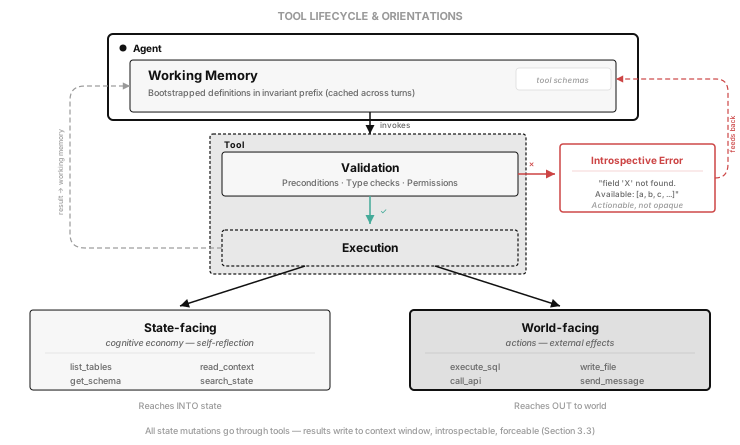
Bootstrapped Tools
Bootstrapped Tools — Tools whose definitions are loaded into working memory at the start of every invocation — always available, always visible, and always occupying context.
Unlike tools discovered or loaded dynamically during execution, bootstrapped tools are present in working memory before the agent's first meaningful turn. How they get there is an implementation choice: they may be included directly in the directives, or loaded via forced tool use (e.g., a read_bootstrapped_definitions call) that populates working memory before the agent begins reasoning. Bootstrapped tool definitions are one component of the broader bootstrap process described in the Working Memory Management deep dive (Section 3.2) — the stage that reconstructs the agent's initial working memory from structured state.
Why this matters: Because language models are causal models with KV caches (see Working Memory above), bootstrapped tool definitions sit in the invariant prefix of the context window. Their key-value representations are computed once and reused across every subsequent turn. This makes them essentially free after the first request — adding a bootstrapped tool increases first-request latency but has near-zero marginal cost for all subsequent interactions within an invocation. This is a fundamental asymmetry that should inform tool placement decisions.
Design implications:
- Stable definitions only — Bootstrapped tools should have fixed descriptions and schemas. If a tool's definition changes between turns, it invalidates the cache prefix and negates the performance benefit.
- Core over convenience — Only tools that the agent needs across most turns belong in the bootstrap set. Rarely-used tools are better loaded dynamically to keep the invariant prefix lean.
- Ordering matters — Place the most frequently used bootstrapped tools earlier in the definition list. Causal attention means earlier tokens have more influence on downstream reasoning, and earlier definitions are more reliably followed.
- Budget awareness — Each bootstrapped tool consumes tokens in every request. A large bootstrap set can crowd out space for actual task content. Monitor the ratio of tool-definition tokens to task tokens.
Examples: In Claude Code, the file read/write/edit tools, bash execution, and search tools are bootstrapped — they are always present because the agent needs them on virtually every turn. Specialized tools like GitHub CLI wrappers or MCP-provided tools may be loaded conditionally based on project context.
Tool Design
Multi-level descriptions
- Short description (like Unix tool summary)
- Detailed documentation (like man pages)
Usage examples
- Show common patterns
- Demonstrate edge cases
Validators
- Check preconditions (e.g., document exists before editing)
- Verify inputs match expected types/formats
Introspective errors
- Provide actionable feedback
- Example: "Query on field 'X' failed: field 'Y' does not exist in schema. Available fields: [...]"
Forced Tool Use
Forced Tool Use — Forcing or injecting simulated tool uses into the agent's context window upon certain actions [7][47].
Examples:
- Claude Code reads a file when users mention it with `@` syntax
- Calling `get_current_tasks()` before the model runs
- Running `get_incoming_messages()` after every model handoff to check for user/system messages
Note: While this could be seen as hooks that run before actions, empirically there is significant value in treating these as injected tool calls rather than separate mechanisms.
Why this works: It leverages the agent's existing tool-use reasoning capabilities while ensuring critical operations always occur.
Communication as a Tool
Communication with users, other agents, or external systems follows the same patterns as other tools: well-defined interfaces, validation of inputs/outputs, and observable effects on state. See Section 3.5 for the full treatment of communication patterns, channel design, and durability across invocations. For inter-agent messaging specifically, see Section 3.7.
3.5 Communication
Communication — The mechanisms through which agents exchange signals with users, other agents, and external systems. Communication channels are tools (Section 3.4) with the same design principles as any other: scoped, observable, and validated.
Principle: Treat communication as a tool.
Communication channels—whether user-facing output, inter-agent messaging (see Section 3.7), or external notifications—should be idempotent where possible, scoped to a clear purpose, and observable. Communication is the mechanism by which the hierarchical system propagates signals, including interruptions (see Section 3.10).
Communication Patterns
Because communication is modeled as tools, different message delivery patterns emerge naturally from tool invocation mechanisms already present in the harness:
On-demand send and receive. The agent calls a communication tool when it decides to. A
send_user_messagetool delivers output; areceive_user_messagetool polls for input. The agent controls timing — it sends when it has something to say, and checks for messages when it wants to. This is the simplest pattern and works for turn-by-turn conversational agents.Polling via forced tool use. The harness forces a
get_incoming_messages()call at the turn boundary — before the model runs, after every turn, or on a cadence defined by the harness. The agent doesn't choose when to check; the harness ensures it always checks. This guarantees message delivery without relying on the agent to remember. Forced polling is how most production systems ensure agents don't miss critical signals — user corrections, system alerts, interruption requests — regardless of what the agent is currently focused on.Asynchronous communication via external queues. Messages arrive while the agent is mid-turn or between invocations. An external message queue (or equivalent) receives them and holds them for delivery. Two sub-patterns apply depending on urgency:
- Enqueue for next turn. The message is placed in the queue and delivered at the next turn boundary (via forced tool use or on-demand polling). The agent processes it when its current turn completes. This is appropriate for supplementary instructions, non-urgent updates, or context additions that can wait.
- Interrupt then enqueue. For urgent signals — the agent has taken a wrong path, a parent agent needs to cancel a subtask, a user wants to redirect — the external system first calls an interrupt method on the harness, which terminates the current model turn. It then enqueues the message so the agent receives it at the start of its next turn. The harness re-invokes the agent with the new message in working memory. This pattern is how interruptions (Section 3.10) are implemented in practice: the signal propagates through the communication channel, not through a separate interruption mechanism.
Practical Example — Enqueue vs. Interrupt During Agent Execution
A user asks an analytical agent to assess the business impact of changing a product's price. The agent begins planning: it decomposes the task into data extraction (pull historical sales, competitor pricing, margin data), analysis (model demand elasticity, estimate revenue impact), and synthesis (compile findings into a recommendation). It starts executing — delegating database queries to subagents, pulling data from multiple sources.
Scenario 1: Enqueue — adding context without disrupting good work.
Midway through execution, the user realizes they forgot to mention something: "Oh — ROI should be the deciding factor, not just revenue." The agent is currently extracting historical sales data from the data warehouse — useful work regardless of how the final analysis is framed. There is no reason to interrupt this. The harness enqueues the message. The agent finishes its current data extraction turns, and at the next turn boundary it receives the user's clarification in its working memory. It adjusts its analysis plan to center ROI — reweighting the metrics it will compute, perhaps requesting additional cost data it hadn't originally planned to pull — and continues. No work was wasted. The data it already extracted is still needed. The correction was integrated cleanly at a natural seam.
Scenario 2: Interrupt — correcting a wrong path before it compounds.
Same task, but this time the user notices something more urgent: the agent is querying the wrong database. It's pulling from a legacy analytics warehouse that was deprecated last quarter — the data there is stale and will silently produce incorrect results. If the agent finishes these queries and builds its analysis on bad data, the entire downstream chain is poisoned: wrong elasticity estimates, wrong revenue projections, a confidently wrong recommendation. The user sends: "Stop — you're hitting the old warehouse. Use the new analytics platform." The harness triggers an interrupt, terminating the agent's current turn mid-execution. The correction is enqueued. The agent re-invokes with the user's message in working memory, re-plans its data extraction against the correct source, and resumes. The wasted work is a few database queries — far cheaper than a wrong analysis built on stale data.
The two scenarios illustrate why the distinction matters. Enqueue-for-next-turn is the right default when the agent is doing useful work and the new information refines rather than invalidates it. Interrupt-then-enqueue is the right default when the agent is on a wrong path and continued execution will compound the error. The harness — not the agent — makes this routing decision, because the agent cannot know that a message is waiting while it is mid-turn.
These same communication patterns extend to inter-agent messaging — see Section 3.7 for how subagents and multi-agent systems use these channels for synchronous and asynchronous coordination.
Communication Channels as Tools
Communication channels are tools and should follow the same design principles as any other tool in the system: scoped, observable, and validated.
Scoped. Each channel should have a clear purpose and audience. A send_user_message tool is distinct from a report_to_parent tool, even if they ultimately use the same underlying transport. Scoping prevents the agent from accidentally sending internal debugging output to the user or routing a user-facing response to a subagent's log. The tool name and schema encode who the audience is.
Observable. Every message sent or received through a channel should be logged as a structured record in state — the Messaging Channel structure class (Section 3.3). This means messages are not fire-and-forget: they are first-class state objects with sender, recipient, timestamp, content, and thread metadata. Observability enables replay, debugging, and evaluation. When an agent makes a poor decision, you can inspect exactly what messages it received and when — the same way you inspect tool call history.
Validated. Outgoing messages should be validated before delivery. For user-facing channels, this might mean checking format constraints, content policies, or length limits. For inter-agent channels, it might mean validating that the message matches the expected schema for the receiving agent's input format. Validation catches malformed messages before they propagate — the same principle as tool input validation (Section 3.4), applied to communication.
Idempotent where possible. For channels that support retry (network failures, timeouts), idempotent message delivery prevents duplicate processing. Message IDs, deduplication logic, or exactly-once delivery guarantees at the transport layer reduce the agent's burden. The agent should not need to reason about "did my last message arrive?" — the channel infrastructure handles this.
Durability Across Invocations
The previous patterns cover messages that arrive during an active invocation — mid-turn (interrupt), between turns (enqueue). But a third temporal window exists: messages that arrive when no invocation is running at all. The agent has finished its work, the model is not being called, the harness is idle — and an async subagent completes, an API callback fires, or a user sends a follow-up message.
This is not an agent problem. The agent is stateless (Section 3.2) — it does not "go down" or "crash." It simply isn't being invoked. The question is entirely about harness design: what does the harness do when async results arrive and there is no active invocation to receive them?
Three patterns address this:
Wake-on-message. The harness monitors registered channels. When a message arrives and no invocation is active, the harness creates a new invocation: it loads persisted state, places the incoming message in working memory, and starts a fresh agent turn. From the agent's perspective, there is no gap — it simply wakes up with a message in its context, indistinguishable from a forced-poll delivery. This is the default pattern for production conversational agents: a user message arrives, the harness spins up an invocation, the agent responds.
Task-driven resumption. Rather than restoring the full previous state, the harness matches the incoming result to a pending Task (Section 3.3) and creates a targeted invocation scoped to that task. The agent receives the task description, the result, and whatever context the task references — not the entire prior working memory. This is more efficient when the system manages many concurrent async operations: each result triggers a focused invocation rather than reloading everything. It also enables routing — different results can wake different agents or agent configurations, because the Task carries metadata about which agent type should handle its completion.
Dead letter. If the invocation has been permanently terminated — budget exhausted, user cancelled, task no longer relevant — results are routed to a dead letter log. They are not processed, but they are observable: the system records that a result arrived, which invocation it was addressed to, and why it was not delivered. Dead letters are an evaluation signal — a high dead letter rate may indicate that the agent is launching async work it cannot follow up on, or that invocations are being terminated too aggressively.
The critical enabling property is state serialization (Section 3.3). If state cannot be persisted and restored, wake-on-message and task-driven resumption are impossible — the harness has nothing to load into the new invocation. This is why serialization is listed as a lifecycle property of structure classes: not for caching convenience, but because it enables the system to survive the gap between invocations. The agent is ephemeral; the state is not.
Note the symmetry with interruption (Section 3.10). Interruption handles the case where an invocation must stop prematurely; durability handles the case where an invocation must start in response to deferred work. Both are harness mechanisms. Both rely on persisted state. And both are invisible to the agent — it does not reason about "was I interrupted?" or "am I resuming?" It simply sees working memory at the start of its turn and acts.
3.6 Contexts
Contexts — Addressable blocks of information that agents can load, search, and reference — the building blocks of context engineering (Section 2.3).
Section 2.3 established context engineering as a principle—the why. This section provides the taxonomy—the what: the concrete primitives that context engineering operates on.
Key properties:
- Addressable → Can be referenced by name/ID
- Selective loading → Different tasks access different contexts
- Scoped access → Contexts may be task-specific or shared
Examples of Contexts
| Context | Description | Properties |
|---|---|---|
| Session Context | Log of session actions | Partially structured (messages + timestamps) |
| Company Documents | Documents owned by Company X | Pre-indexed as knowledge graph |
| Subagent Log | Record of subagent actions | Read-only, time-bounded |
| Memories | Long-term memory store | Read-write, persistent |
Context variations:
- Text-only vs. enriched/searchable
- Read-only vs. read-write
- Agent-specific vs. shared
Why contexts deserve special attention: Contexts are the lifeblood of agentic applications, but different systems handle them differently:
- Claude Code → Greps over files (filesystem as context)
- Cursor → Maintains code index with semantic search
- Recursive Language Models → Maintains prompt as context (string)
Progressive Disclosure in Practice
The chicken-and-egg problem: How does the agent know what to load into working memory without already knowing what's in state?
Solution: State-facing tools that operate at different levels of granularity, letting the agent narrow from broad discovery to targeted retrieval. Each step loads more detail but less breadth — and each result enters working memory, informing the agent's decision about what to load next:
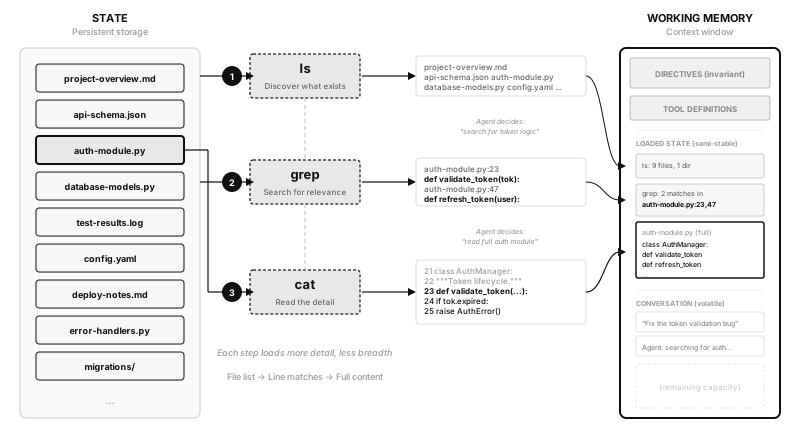
ls— Discover what exists. The agent sees file names, context titles, or entity counts — enough to orient but not enough to reason. This enters working memory as a lightweight index: a few tokens that represent the shape of the available state.grep— Search for relevance. Armed with the index, the agent searches for specific patterns or keywords. The result is a set of location-qualified matches — file, line, snippet — that tell the agent where the relevant content lives without loading all of it.cat— Read the detail. The agent loads the specific content it needs in full. This is the most expensive step in tokens but also the most targeted: the agent knows exactly what it is reading and why.
Each step is a tool call whose result enters working memory as turn content (category 3 in the taxonomy). The agent decides between steps — it may skip directly from ls to cat if the file name is sufficient, or iterate multiple grep calls before committing to a full read. The key property is that the agent controls the disclosure rate: state is not dumped into working memory wholesale but surfaced incrementally, with the agent trading off token cost against information need at each step.
Forced Contexts
Definition: Automatically loading entire contexts into working memory when appropriate.
This is a specific case combining:
- Progressive disclosure
- Forced tool use
When to use:
- Context is small enough to fit in working memory
- Context is highly relevant to the task (e.g., editing a file → load the file)
- Cost of loading is lower than cost of multiple queries
Note: This is "context stuffing" from pre-RAG LLM systems, but it remains highly effective for the right problem sets.
Retrieval Mechanisms (RAG, GraphRAG, grep, etc.)
Principle: All retrieval mechanisms are context access patterns.
RAG [48] pioneered the pattern of augmenting generation with retrieved documents. GraphRAG [49] extends this by constructing knowledge graphs over corpora for more structured retrieval.
However, recent production systems have revealed a significant shift in how retrieval actually works in structured domains. Claude Code, Aider, and similar coding agents have largely moved away from semantic search (embedding similarity over chunked documents) toward what can be called agentic search—retrieval driven by the domain's own structure rather than by vector proximity [81][82][83].
Aider's repo-map approach [82] illustrates this well: rather than embedding and retrieving code chunks, it builds condensed tree-sitter outlines of the repository—a structural summary that lets the model navigate the codebase by understanding its organization (modules, classes, function signatures, dependency graphs). Claude Code [7] takes a complementary approach: grep-over-filesystem, file tree exploration, and symbol-level navigation. In both cases, retrieval exploits the inherent structure of the domain to guide the model to relevant information, rather than relying on semantic similarity between a query embedding and document embeddings.
This distinction maps cleanly onto domain type. For structured domains (codebases, databases, APIs, configuration systems), agentic search works because the domain provides navigable structure—file hierarchies, type systems, dependency graphs, schema definitions. The retrieval mechanism can follow the domain's own organization. For unstructured domains (document corpora, knowledge bases, conversation histories), that navigable structure doesn't exist natively. We must create it—via indexing, knowledge graphs (GraphRAG [49]), or other enrichment—before agentic search becomes viable. This is why GraphRAG exists: it manufactures the structural scaffolding that code and databases get for free.
This is a special case of the contexts taxonomy above: different retrieval mechanisms are different strategies for accessing contexts, each with tradeoffs in precision, recall, latency, and setup cost. Traditional RAG trades setup cost (embedding, chunking, indexing) for broad recall across unstructured corpora. Agentic search trades generality for high precision in structured domains—it's fast and accurate when the domain has navigable structure, but inapplicable when it doesn't. GraphRAG occupies a middle ground: it invests heavily in creating structure (knowledge graph construction) to enable structured retrieval over originally unstructured data. The choice between these mechanisms is itself a context engineering decision—matching the retrieval strategy to the structure (or lack thereof) of the domain.
3.7 Subagents & Multi-Agent Systems
The previous sections establish the primitives of a single agent: its state (Section 3.3), tools (Section 3.4), communication channels (Section 3.5), and contexts (Section 3.6). But most production systems involve more than one agent. Two fundamentally different patterns govern how agents relate to each other, and the distinction matters because it determines state visibility, lifecycle coupling, and the communication mechanisms available.
Subagents are, in a meaningful sense, part of a larger agent. A subagent is spawned by a parent agent — typically via a tool call — and operates within the parent's invocation lifecycle. The subagent's lifetime is bounded by the parent's: it is created during the parent's execution, performs its work, and terminates before (or when) the parent completes. This containment relationship enables the hierarchical patterns discussed throughout this framework: parent-child delegation (Section 3.4, Forced Tool Use), interrupt propagation from parent to child (Section 3.10), synchronous and asynchronous composition via shared communication channels (Section 3.5), and scoped state sharing where the parent grants the subagent partial or complete access to its own state. The subagent inherits its operating context from the parent — its existence is not independent but derived.
Multi-agent systems involve agents that share no state. Each agent exists as part of the world of every other agent (Section 3.1) — an external entity to be observed and communicated with, not an internal component to be directly controlled. Their invocations are independent: one agent's lifecycle is not contained within another's. They may run concurrently, sequentially, or with non-overlapping lifetimes entirely — one agent may complete its work long before another begins. Because there is no shared state, all coordination must happen through explicit message passing over communication channels, and each agent must treat the other's outputs as external, potentially stale data subject to the same staleness concerns as any other world observation (Section 3.3).
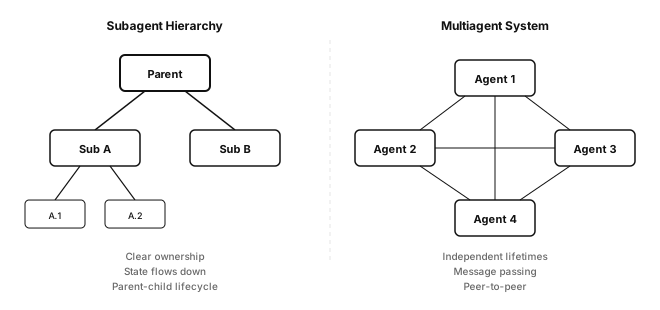
Subagents
A subagent is an agent invoked by another agent — typically via a tool call — that has its own context access, directives, and tools [24][51]. What makes it a subagent, rather than an independent peer, is that its configuration is provided by the parent. The parent composes the subagent from four elements: directives that define the subagent's role, tools that determine the subagent's action space, a state schema that determines what state the subagent can access, and bootstrap forced tool calls that initialize its working memory. These are the same primitives used to configure any single agent (Sections 3.1–3.3) — the difference is that the source of configuration is a parent agent rather than an external harness.
Subagent Directives
The parent selects or generates the subagent's directives — the same concept as Section 3.1, but with a different source. For well-known subtasks, the parent picks from predefined roles: a code-review agent, a search agent, a test-runner agent, each with a fixed directive set that the harness makes available. For novel or context-dependent subtasks, the parent dynamically generates directives: it composes a role description, constraints, and success criteria based on its current working memory and the specific delegation need. In both cases, the directives are provided by the parent — this is the definitional characteristic of a subagent. The subagent does not choose its own role; its role is assigned.
Subagent Tools
The parent configures which tools the subagent has access to — a subset of the parent's own tools, the full set, or a curated set that includes tools the parent doesn't use itself. This is the primary lever for cognitive economy (Section 3.3, Tools as State): a narrower tool set means a smaller action space, which means less reasoning overhead per turn. A subagent given three tools instead of thirty can focus its reasoning on the task rather than on tool selection.
Tools can also be bootstrapped — the parent can include tools that the subagent discovers or loads during its bootstrap phase, extending its capabilities beyond the parent's own tool set. A parent that delegates a database migration task might equip the subagent with schema-inspection tools the parent itself never uses. A parent that delegates a research task might give the subagent web-search tools that the parent's own directive set excludes. The tool set is not a fixed slice of the parent's capabilities; it is a composed capability set tailored to the subtask.
The tool set should be focused by default but extensible when needed. This connects to the Permeable Boundaries principle (Section 2.6): hard tool walls — where the subagent simply cannot access a tool it turns out to need — create the tool segmentation failures described in Delegation Challenges below. The subagent encounters an unexpected need, lacks the tool to address it, and must fail or escalate. Soft boundaries, where additional tools are accessible but not loaded by default, prevent this. The subagent starts with a focused tool set for cognitive economy, but can request or discover additional tools when the task demands it — preserving focus in the common case while avoiding catastrophic gaps in the edge case.
Subagent State
The parent configures the subagent's state schema — the collection of structure classes (Section 3.3) that constitutes the subagent's state. This schema may be independent (entirely fresh state, no overlap with the parent) or shared (overlapping structure classes that give the subagent access to some or all of the parent's state).
Independent state is simple: the subagent operates in isolation, and its results flow back to the parent as a tool return value. Shared state is more powerful but introduces the same problems the framework's state design prevents for single agents (Section 3.3, State Staleness): shared mutable state creates staleness and race conditions. If the parent continues working while a subagent modifies shared state, both may operate on assumptions that the other has invalidated.
Copy-on-invocation with reducer reconciliation is the recommended pattern for safe state sharing:
- Snapshot: Shared structure classes are copied at invocation time — the subagent receives a frozen snapshot of the parent's current state.
- Isolation: The subagent modifies its copy freely during execution. No writes propagate to the parent in real time.
- Reconciliation: On completion, a reducer function merges the subagent's modified state back into the parent's current state. The reducer handles conflicts — last-write-wins, merge, reject, or custom logic — based on the structure class's semantics.
This pattern is inspired by LangGraph's state machine design [111], where each node in the graph receives a state copy and returns updates that are merged via reducers. The pattern is the same: isolate mutation during execution, reconcile on completion.
When isolation breaks. Some domains resist clean isolation. Coding agents operating on a shared filesystem cannot fully snapshot and isolate file state — two agents editing the same file will conflict regardless of state-layer protections. In these cases, accept the breakage and compensate at the domain level: git worktrees for filesystem isolation, file locking for critical sections, or optimistic concurrency with conflict detection. This connects to the coding agent deep dive in Section 3.3: the filesystem is the state, and its concurrency model is the filesystem's, not the framework's.
Subagent Bootstrap
The parent configures forced tool calls for the subagent's bootstrap (Section 3.2) — the same mechanism used for single agents, but parent-configured rather than harness-configured. These bootstrap calls load contexts, read messaging channel messages, query task state, and otherwise initialize the subagent's working memory before it begins autonomous reasoning.
This directly addresses scope rediscovery (Section 3.7, Delegation Challenges). The working-memory discontinuity described there — where a subagent must spend tokens re-establishing context the parent already has — is converted from an unstructured problem into a structured state-loading operation. Instead of hoping the subagent will figure out what context it needs, the parent explicitly loads the relevant state into the subagent's working memory via bootstrap. The rediscovery penalty becomes a predictable, optimizable initialization cost.
Subagent composition as single-agent configuration. Decomposing subagents into directives + tools + state schema + bootstrap means that subagent creation uses the same primitives as single-agent configuration. Tool scoping uses existing tool configuration. State sharing uses existing structure classes. Context transfer uses existing bootstrap. No separate "subagent protocol" is needed. This uniformity has a practical consequence: state sharing and context rediscovery prevention are achieved within the framework's existing concepts, not layered on top of them. Furthermore, because subagents can produce tasks as structured state (Section 3.3), and tasks reference execution logs as associated contexts, the parent gains structured introspection into the subagent's work — not just its final output, but the trajectory that produced it.
Subagents vs. Multiagent Systems
| Aspect | Subagents | Multiagent |
|---|---|---|
| Lifetime | Contained within parent's invocation lifecycle | Independent, potentially non-overlapping lifetimes |
| Relationship | Parent-child hierarchy | Peer-to-peer |
| State sharing | Easy (by design) | Complex (requires explicit channels) |
| Communication | Direct invocation | Message passing |
When to use subagents [50]:
- Clear hierarchical task decomposition
- Need to isolate context/tools for subtask
- Want to reuse subagent across multiple invocations
- State sharing is important
Inter-Agent Messaging
The communication patterns established in Section 3.5 apply directly to inter-agent messaging. There is no separate "inter-agent protocol" — agents communicate through the same tools they use for user communication, because from the agent's perspective, a message is a message regardless of sender.
Synchronous composition. A parent agent launches subagents and waits for results. The subagent's return value flows back as a tool result. When the subagent completes, its output — structured results, state updates, error reports — is delivered to the parent's working memory. This is the simplest inter-agent pattern and is identical to calling any other tool that happens to run a model internally.
Asynchronous composition. A parent agent launches subagents and continues its own turns while subagents operate independently. The parent uses receive_agent_messages() — on-demand or forced — to check for results. Subagents write their outputs to shared state or message channels that the parent can poll. This pattern enables parallelism: the parent can launch multiple subagents, continue working on other tasks, and process results as they arrive.
Response severity and escalation. Inter-agent messages carry the same severity spectrum as user messages. A subagent reporting intermediate progress can be enqueued for the parent's next polling cycle. A subagent reporting a critical failure — "the database schema doesn't match expectations, all queries will fail" — should trigger the interrupt-then-enqueue pattern on the parent, because the parent's current plan may be based on invalid assumptions. The severity classification is the same mechanism described in Section 3.5 for user messages: the external system (harness) decides whether to enqueue or interrupt based on the message's metadata, not the agent itself.
This symmetry — user messages and agent messages flowing through identical pathways — is a deliberate design choice. It means the agent doesn't need separate reasoning about "how to talk to users" versus "how to talk to other agents." It also means the same testing infrastructure works for both: you can simulate user trajectories and inter-agent exchanges through the same message channels, and the agent cannot distinguish synthetic test messages from real ones (as noted in Section 3.2).
The existence of asynchronous agents and tasks in general motivates the Task structure class (Section 3.3) as a recommended — though not core — component. When agents can launch work that outlives a single turn, something must track what was launched, what has completed, and what is still pending. Tasks provide this tracking. Without them, the parent must maintain this bookkeeping in unstructured working memory, which degrades as the number of concurrent activities grows.
Delegation Challenges
Delegation—whether to subagents or across multi-agent systems—introduces costs that are easy to underestimate. Two failure patterns dominate production systems:
Scope rediscovery. Each delegated agent starts with a fresh or partial context window. The parent agent has built up a rich working memory over the course of the task—observations, intermediate results, implicit assumptions, domain context. When it delegates to a subagent, much of this working memory must be re-established in the subagent's context. This creates a working-memory discontinuity (see Section 2.3): the subagent must spend tokens and reasoning cycles recontextualizing before it can do useful work. The more complex the parent's accumulated context, the more expensive this rediscovery becomes. This is why delegation works best for tasks that are relatively self-contained—where the required context can be transmitted cheaply and the subagent doesn't need to reconstruct the full reasoning history of the parent.
Tool segmentation failures. In systems with a router or orchestrator that dispatches tasks to specialized agents, a common failure mode is routing to an agent that lacks the right tools or context for the task. The agent attempts the task, fails, and the error bubbles back up to the router, which must retry—potentially multiple times—before either finding the right agent or escalating. This retry cycle compounds latency and cost, and is especially pernicious because it's often silent: the system eventually succeeds, masking the inefficiency. Structured composition (clear tool boundaries, explicit capability declarations, well-defined routing rules) mitigates this, but doesn't eliminate it. This pattern connects directly to the error handling concerns in Section 3.10.
The upshot: delegation is not free. It works best for cheaper, more reliable subtasks where the cost of recontextualization is justified by the benefits of isolation, parallelism, or specialization. When a subtask requires deep access to the parent's accumulated context, the cost of transmitting that context may exceed the cost of simply having the parent do the work itself.
Skills
Definition: Pre-packaged instructions and context bundles.
Skills encapsulate:
- Domain knowledge
- Common patterns
- Best practices
- Tool combinations
Purpose: Reduce repetition and improve consistency for common task types.
Counterpoints & Discussion
The hierarchical subagent model is not the only viable approach. Du et al. [52] show that peer-to-peer debate between agents boosts factuality beyond what hierarchical approaches achieve. Li et al. [53] demonstrate that single-agent skill selection degrades non-linearly as skill libraries grow, suggesting multi-agent architectures still win for complex systems. OpenAI's Swarm [74] explores lightweight peer-to-peer orchestration as an alternative to strict hierarchies. More fundamentally, pure hierarchical models may sacrifice robustness—flat topologies can be more fault-tolerant when individual agents fail [75].
Composition defines the who of agent systems. Tasks define the unit of work composed agents operate on. Planning defines the what and when—the mechanism by which composed agents coordinate that work.
3.8 Tasks
Task — A structured object that encapsulates a unit of computation: its goal, lifecycle state, parent, children, result slot, and synchronization primitives. Every unit of work in a structured agent system — from a single tool call to the top-level invocation — can be modeled as a task.
An agent system has many shapes of work. A tool call returns a result. A subagent invocation does the same, but takes longer. A retrieval can fan out into parallel queries that must be joined. The user's request is itself work the system has accepted. Without a unifying abstraction, each of these has its own lifecycle, its own way to wait on completion, and its own way to be stopped. Tasks collapse these shapes into one structural unit, and that unification is what makes asynchronous, interruptible, and recoverable agent execution tractable.
Tasks were introduced as an extended structure class in Section 3.3 — lifecycle metadata over a unit of work. This section develops the claim that they belong at every level of agent computation, not only as items in a plan.
Tasks as the Unit of Computation
A task is the smallest object the harness can address. It can be created, observed, awaited, cancelled, and finalized. It carries:
- Identity — so other parts of the system can reference it across turns and invocations.
- Parent and children — so signals (failure, cancellation, replanning) can propagate along the hierarchy.
- Lifecycle state — created, scheduled, running, blocked, completed, failed, cancelled. Transitions are typed and validated like any other structure class (Section 3.3).
- Goal description — what success looks like for this task, captured at creation rather than reconstructed from working memory.
- Result slot — what the task produces, written exactly once at terminal state. This is the addressable artifact that consumers reference; the result lives separately from the task object so other tasks and agents can read it without parsing task metadata (the decomposition described in Section 3.3 — task, result, and execution log as three separable concerns).
- Synchronization primitives — the operations that let other tasks await it, cancel it, or attach handlers.
Most production systems already implement these properties for some subset of work — futures and promises in async runtimes, jobs in orchestration frameworks (Celery, Temporal, Airflow), the operating system's process abstraction. The contribution here is recognizing that the same structural object covers every level of agent computation, not just the orchestration layer.
Tool calls generate K tasks. When the agent calls a tool, the harness creates a task for that call. K is one in the simplest case (a synchronous tool that returns a value). It is more than one when the tool's semantics are inherently parallel: a multi-query tool that fans out to several datasources creates one parent task and K child tasks; a batched action tool creates a parent and one task per item. K can be zero in degenerate cases (a tool that schedules deferred work and returns immediately, where the scheduled work is a separate task whose lifecycle outlives the current turn). Treating tool calls as task-generating means the harness tracks, time-bounds, and cancels them uniformly, regardless of whether the work runs in-process, on a worker pool, or in another agent.
Tasks can have subtasks. A task may decompose into sub-tasks — sequential, parallel fan-out, or a DAG. The parent observes children through the same primitives it offers its own caller: await, cancel, status inspection, result reads. This makes the framework recursive: a subagent invocation (Section 3.7) is structurally identical to a tool call from the parent's perspective. Both are tasks the parent created and is responsible for. The difference is only in what the task encapsulates — a single function execution versus an entire agent invocation — not in how the parent interacts with it.
The main agent is itself a task. The top-level invocation is the root task. Whatever launched the agent — a user message, a scheduler, a parent agent — is its caller. The invocation lifecycle from Section 3.2 (start, run, terminate, return result) is the lifecycle of this root task. This collapses the apparent distinction between "the agent" and "what the agent does": at every level the agent is a task, and the harness operates on it through the same primitives it uses for any other task. There is no separate "invocation API" and "task API" — there is one set of operations, applied uniformly from the root down to the leaves.
Asynchronous programming becomes the default. Once tasks are first-class, the harness gets concurrency for free. A tool call that takes ten seconds does not block other tasks — its task awaits in the background while the parent continues. A user message arriving mid-execution is just another task entering the queue. Long-running subagent invocations can be spawned, polled, and joined without bespoke control flow. The patterns are the same patterns familiar from structured concurrency in modern programming languages — Python's asyncio, Go's goroutines, Rust's async/await, Erlang's processes — applied at the level of agent computation rather than at the level of a single program. Without tasks as a uniform abstraction, every async pattern in the harness becomes bespoke; with them, the harness inherits decades of work on cancellation, structured concurrency, and supervision trees.
Tasks satisfy the structure class lifecycle. The properties from Section 3.3 apply directly. Tasks are created through tools, mutated through typed transitions (a task cannot move from completed back to running), validated against invariants (a task cannot complete if it has uncompleted required children), kept consistent at every observation, and serialized across invocation boundaries. A task that started in one invocation and was awaiting an external result can be reconstituted in a later invocation when the result arrives — task-driven resumption (Section 3.5, Durability Across Invocations) made concrete.
Synchronization Primitives
Because tasks are first-class, the harness offers a small, predictable set of primitives that work uniformly across tool calls, subagent invocations, and the root invocation:
spawn(goal, parent)— Create a task and start it. Returns a task identity.await(task)— Block (or yield) until the task reaches a terminal state.cancel(task, reason)— Request that the task stop. Cooperative by default, with the option to escalate to forced termination if the task does not yield.status(task)— Read the current lifecycle state.result(task)— Read the task's result once terminal.children(task)/parent(task)— Navigate the hierarchy.
The agent does not call spawn directly — it calls a tool, which the harness implements by spawning a task. The same applies to await, cancel, and the rest: when the agent needs to manipulate one of its in-flight tasks (for instance, to cancel a deferred subtask that is no longer needed), the harness exposes the primitive through a tool. This keeps the agent-facing interface within the framework's discipline (all action through tools, Section 3.4) while giving the harness a uniform internal vocabulary for managing work.
The synchronization primitives are also where the harness implements the discipline that the agent does not have to reason about: budget enforcement (a task that exceeds its token or wall-clock budget is cancelled), supervision (a task whose parent terminates is cancelled in turn), and recovery (a task whose result is required for a future invocation persists across the gap). The agent never sees this machinery directly — it sees only the tools and their results — but the machinery is what allows long-running, durable, and interruptible computation to be expressed without each tool reinventing the same primitives.
Patterns Enabled by Task Encapsulation
A task outputs to the state and to the world. Once that output channel is owned by a task with synchronization primitives, several patterns that would otherwise require bespoke machinery in every harness become straightforward.
Interruption-aware state mutation. A tool that mutates state can be designed as a task with an explicit yield point between observation and commit. After it has determined what change to apply but before it commits, the task checks whether an interruption signal is in flight for its identity. If one is present, it abandons the mutation; if none, it commits. The canonical case is human-in-the-loop confirmation: the tool waits on a signal from the user, treats arrival of approval as the green light to commit, and treats explicit rejection (or a timeout that elapses without approval) as an interruption that aborts. World-facing tools admit the same pattern wherever the side effect can be staged before commit — file writes that prepare a tempfile and rename only after a confirmation, API calls held in a pending queue, deferred message sends. Without tasks as a structural primitive, every state-mutating tool reinvents this checkpointing protocol; with them, the harness provides the cancellation channel and the tool just needs to expose the safe-yield point.
Cancellation preserves work without committing state. A cancelled task should not leave half-applied state, but cancellation does not require throwing the work away. The task can log what it observed, what it was about to do, and where the cancellation arrived — to its execution log or to a Context (Section 3.6) — without ever committing the state mutation it was preparing. The parent uses that trail to replan: the cancelled task produced no result, but it produced enough information about why it stopped and how far it got that the next attempt does not start from zero. This is the difference between cancellation as "throw it away" and cancellation as "pause this branch but remember what you learned." Both are valid; the second is what keeps multi-step recovery tractable in long-horizon work, because the cost of a cancelled task is bounded by what it logged, not by what it would have produced if it had completed.
Background tasks with UX continuity. Long-running tasks need not block the agent that spawned them. Because a task is addressable state, the harness can hand the user off to a companion agent that is aware of the in-flight work without doing the work itself. The worker continues in the background; a companion — initialized from the same state, with read access to the worker's task — takes over the conversation. The companion does not duplicate the work. It inspects the task's status, summarizes progress to the user, fields questions about the operation in flight, and accepts new requests that can be queued behind or alongside the worker. When the worker completes, its result becomes available through the same task primitives the companion was already using to observe it. This is a UX move that only works because tasks are first-class state: the companion knows what the worker is doing because it can read the worker's task object, not because the harness duplicated the worker's working memory. The same primitive that lets a parent agent observe a child subagent (Section 3.7) is what lets a UX-facing companion observe a backgrounded worker — it is the same composition pattern, applied at the boundary between the user and the system rather than between two agents.
3.9 Planning
Planning is the mechanism by which agents decide what to do before doing it [58]. While reactive agents execute actions step-by-step based on immediate observations, planning introduces deliberation—a lookahead that evaluates potential action sequences before committing.
Planning is best understood as pre-runtime verification—an analogue of compilation. Just as a compiler catches type errors, unresolved references, and unreachable code before a program runs, a planning phase catches invalid action sequences, unsatisfied preconditions, and resource conflicts before the agent commits to execution. The economics are compelling: cheap verification signals—schema checks, precondition validation, syntax parsing—run in milliseconds at negligible compute cost, and their precision reduces the reasoning the model must do on its own. The model does not need to think about whether a query's output schema matches a join condition if a deterministic checker can answer that in microseconds. Planning time shrinks when verification signals are fast and cheap, because the model offloads the hard parts to external checks and focuses its token budget on what only it can do: creative decomposition and goal reasoning. Execution, by contrast, is expensive (API calls, database writes, external side effects that may be irreversible). Without planning, an agent might invoke an expensive data transformation tool only to discover that the next tool in the sequence requires a property of the output that was never produced—forcing a costly redo. Planning catches this class of error at planning-time cost rather than execution cost.
Why Planning Matters
Without planning, an agent's behavior is purely reactive: observe → act → observe → act [56]. This works for simple tasks but fails when:
- Actions are expensive or irreversible
- The task requires coordination across multiple steps
- Dependencies between subtasks constrain execution order
- The agent must reason about resource allocation (tokens, API calls, time)
Principle: Planning amortizes the cost of reasoning over the execution of a task [62].
Plan Representations
How a plan is represented determines what the agent can reason about:
| Representation | Structure | Strengths | Weaknesses |
|---|---|---|---|
| Natural language | Free-form text outline | Flexible, human-readable | Hard to validate, ambiguous |
| Task lists | Ordered/unordered items with status | Trackable, supports dependencies | Limited branching logic |
| DAGs | Directed acyclic graphs of subtasks | Explicit dependencies, parallelizable | Complex to construct |
| State machines | States + transitions | Deterministic, verifiable | Rigid, poor for novel tasks |
| Hierarchical plans | Nested subtask trees | Natural decomposition, progressive detail | Can lose cross-branch context |
In practice, each representation occupies a different point on the formality-flexibility spectrum. At Kuona, we use PDDL-style representations with declared preconditions and effects for tool sequences—a formal alternative that enables deterministic verification (see Verification-Driven Planning below). This bridges the gap between state machines (deterministic but rigid) and DAGs (parallelizable but lacking formal verification): precondition/effect declarations give the planner enough formal structure to verify soundness while remaining flexible enough to compose novel tool sequences that were not anticipated at design time.
Planning Strategies
Decomposition
Breaking a task into subtasks before executing any of them — the most common planning pattern in current agentic systems [60][61]. Common variants include top-down decomposition (recursively splitting a goal into subgoals), means-ends analysis (identifying the gap between current and goal state and finding actions that close it), and template-based planning (matching the task to a known plan and filling in specifics). The shared assumption is that subtasks can be reasoned about — and validated — independently of one another; when that holds, decomposition makes the plan legible and the failures local.
Search-Based Planning
Exploring multiple possible action sequences and selecting the best one. Tree-of-thought [55] generates and evaluates several reasoning paths, Monte Carlo methods sample rollouts to estimate value, and best-first search [59] expands the most promising partial plan first. Search earns its overhead when the action space is large enough that the first plausible plan is unlikely to be the best — and when scoring a candidate is meaningfully cheaper than executing it.
Verification-Driven Planning
Using validation signals to guide plan construction—plans are iteratively refined until they pass verification checks.
Connection to the Validation Cost Asymmetry (Section 2.2): Planning is where the validation cost asymmetry pays its highest dividends. If verification signals are faster and cheaper than execution—and they almost always are—then verify-before-execute dominates execute-then-recover on cost, speed, reliability, and determinism. A single verification pass over a proposed plan can prevent multiple expensive execution failures. Planning exploits a temporal asymmetry: by shifting verification to before execution, the agent converts what would be runtime failures (expensive, stateful, potentially irreversible) into planning-time rejections (cheap, stateless, trivially retried).
Formal plan verification with preconditions and effects. In Kuona, we model the agent's own state as a PDDL-like initial state. Each tool declares preconditions (predicates that must hold before invocation) and effects (predicates that become true or false after execution). Example predicates include ran-query-this-plan, document-abc-exists, document-xyz-not-exists, and generated-graph.
The agent proposes a plan—a sequence of tool calls. A formal verifier then checks: given the initial state and the cumulative effects of each preceding step, do all preconditions hold at every step? Does the final state satisfy the goal predicates (e.g., generated-graph = true)? If verification fails, the agent receives a cheap, precise signal about which precondition failed and where in the plan, enabling targeted revision rather than blind retry.
The agent iterates: propose → verify → revise, until the plan is logically sound. This loop is cheap—formal verification runs in milliseconds and is deterministic—compared to execution, which takes seconds to minutes, costs real resources, and may produce irreversible side effects. The propose-verify-revise loop is structurally identical to the compile-fix cycle in software development: the planner is the developer, the verifier is the compiler, and a passing verification is the equivalent of a clean build.
Practical Example — PDDL-Style Plan Verification at Kuona
A user asks: "Show me a graph of monthly revenue by region." The agent proposes a plan:
generate-graph— render the visualizationrun-query— fetch monthly revenue data grouped by region
Initial state: { ran-query-this-plan: false, generated-graph: false }
The verifier checks step 1: generate-graph requires precondition ran-query-this-plan = true. Current state has ran-query-this-plan = false. Verification fails. The error message is precise: "Step 1 (generate-graph): unsatisfied precondition ran-query-this-plan."
The agent revises — swap the order:
run-query— fetch monthly revenue data grouped by regiongenerate-graph— render the visualization
The verifier re-checks. Step 1: run-query has no preconditions → passes. Effects: ran-query-this-plan = true. Step 2: generate-graph requires ran-query-this-plan = true → state now satisfies this. Effects: generated-graph = true. Final state: { ran-query-this-plan: true, generated-graph: true }. Goal predicates satisfied. Verification passes.
This entire loop — propose, reject, revise, verify — took milliseconds. Without it, the agent would have attempted to render a graph with no data, received a runtime error, then had to reason about what went wrong and retry — a process measured in seconds and tokens rather than microseconds and deterministic checks.
Schema-aware multi-query planning. A second pattern from Kuona addresses data retrieval across heterogeneous datasources. The goal is to produce data matching a target schema. The planner decomposes this into individual queries to different datasources—including joins between query results—culminating in a unifying query that produces the final output.
Verification signals validate the plan before any query executes: (1) each query's output schema is compatible with proposed joins, (2) the final unified schema matches the target. These checks are cheap deterministic operations—schema compatibility is type checking—applied before any expensive datasource interaction occurs. Notably, the plan does not specify exact SQL for each datasource. Instead, each subagent receives a natural language description of what data it must produce and which datasource to query. This shifts the responsibility of determining the best query strategy—dialect-specific syntax, available operations, optimization—to the subagent that owns the datasource interaction. The parent plans at the level of data contracts (schemas in, schemas out), not implementation details.
Once the plan passes verification, individual queries are delegated to parallel subagents for execution. If a subagent fails (e.g., a datasource does not support a required operation), it first attempts local recovery. If local recovery fails, it escalates to the parent planner. The parent then: (1) interrupts all sibling agents—their work is now potentially invalid given the changed assumptions, (2) incorporates the failure information into its model of what went wrong, and (3) replans from the current state with the new constraint. This failure-triggered replanning connects directly to Interruptions, Cancellations, and Preemption (Section 3.10): the subagent's escalation is an interruption that propagates up the agent hierarchy, and the parent's response—halt siblings, replan, re-delegate—is the structured recovery pattern that hierarchical composition enables.
Practical Example — Schema-Aware Multi-Query Planning at Kuona
A user asks: "Compare promotional lift across online and in-store channels for Q4." The target schema requires columns: promotion_id, channel, baseline_revenue, promo_revenue, lift_pct.
The planner produces:
- Query A (Snowflake) → fetch online transaction data, output schema:
{ promotion_id, revenue, date, channel="online" } - Query B (PostgreSQL) → fetch in-store POS data, output schema:
{ promo_code, store_revenue, sale_date, channel="in-store" } - Query C (local) → join A + B on
promotion_id = promo_code, computelift_pct, and project to target schema
Verification checks: (1) The join key promotion_id from Query A is compatible with promo_code from Query B — both are string-typed identifiers. (2) The unified output after the join and projection matches the target schema. Verification passes.
Each subagent receives a natural language description — e.g., "From the Snowflake warehouse, retrieve per-promotion online revenue for Q4 2024" — not raw SQL. The subagent determines the best query strategy for its datasource.
Failure scenario: The PostgreSQL subagent discovers that the POS system stores promo_code as a composite key (store_id + promo_id) that cannot be directly joined with promotion_id. Local recovery fails — the subagent cannot resolve the key mismatch on its own. It escalates to the parent.
The parent: (1) interrupts the Snowflake subagent (its results may need different join logic), (2) incorporates the constraint — "POS promo_code is a composite key requiring decomposition" — and (3) replans. The revised plan adds a transformation step to decompose promo_code before the join. The new plan is verified, and execution restarts with updated subagent assignments.
Plan Execution
A plan is only as good as its execution. Key concerns:
- Plan following vs. replanning → When should an agent stick to the plan vs. replan?
- Monitoring → How does the agent detect plan divergence?
- Checkpointing → Where can execution resume if interrupted?
- Partial execution → Can subtasks be executed out of order when dependencies allow?
Principle: Plans should be treated as hypotheses, not commitments [57]. The agent should be willing to abandon or revise a plan when observations invalidate its assumptions.
Replanning triggers. Plans are hypotheses, and hypotheses can be invalidated. In Kuona's multi-query planner, replanning is triggered when a subagent escalates a failure that invalidates plan assumptions—for instance, when a datasource lacks support for a required operation. Note that schema mismatches within a single query are caught by formal verification inside the subagent itself; what surfaces to the parent is a different class of error: the plan's own assumptions were incorrect. The datasource cannot deliver what the plan assumed it could. This triggers replanning—or, if no alternative plan can satisfy the goal, planning failure. The replanning process reuses the formal verification loop: the parent proposes a revised plan that accounts for the new constraint, verifies it, and re-delegates. Critically, the parent does not simply retry the failed step; it reconsiders the entire plan in light of what it has learned, because a single invalidated assumption can cascade through downstream dependencies.
Planning and Composition
Planning interacts closely with composition (Section 3.7):
- Subagent delegation → A plan can assign subtasks to subagents
- Skill matching → Planning can involve selecting which skills to invoke
- Resource budgeting → Plans can allocate context window space, API calls, or time budgets across subtasks
Kuona's schema-aware query planner illustrates this integration concretely. The planner decomposes a data retrieval goal into individual queries, verifies the plan formally (schema compatibility, SQL validity, target schema match), then delegates each query to a parallel subagent. The plan is the contract between parent and children: it specifies what each subagent must produce, what schema its output must conform to, and how outputs will be joined. When a subagent fails and escalates, the parent interrupts siblings (their assumptions may be invalid), incorporates the failure, and replans—demonstrating the tight coupling between planning, parallel delegation, and failure-triggered replanning. This pattern generalizes: any system where a parent decomposes work, delegates to children, and must respond coherently to partial failure benefits from a verified plan that makes the assumptions explicit and the recovery path structural rather than ad hoc.
Counterpoints & Discussion
The value of explicit planning is debated. Snell et al. [76] show that scaling test-time compute—simply giving a model more tokens to think—can match or beat structured planning approaches. Plan caching [77] reveals that planning overhead is non-trivial and can be amortized. Google DeepMind [78] finds that frontier models working alone can outperform agent teams on many benchmarks, questioning whether planning-heavy orchestration is always justified. Chain-of-thought prompting [54] itself can be seen as implicit planning that emerges from the model rather than being imposed externally.
3.10 Error Handling & Recovery
Agents fail. Tools return errors, APIs time out, models hallucinate [17]. The question is not whether failures occur, but how the system responds [63].
Failure Modes
| Mode | Description | Example |
|---|---|---|
| Tool failure | A tool call returns an error or unexpected result | API rate limit, file not found |
| Reasoning failure | The agent produces an incorrect or incoherent plan | Hallucinated tool name, circular logic |
| State corruption | State becomes inconsistent due to partial writes | Half-completed database migration |
| Context degradation | Key information scrolls out of the context window | Losing track of the original goal |
| Composition failure | A subagent fails or returns unusable results | Subagent hits token limit, returns garbage |
Recovery Strategies
Five strategies cover most failure modes. Retry with backoff handles transient failures like network blips and rate limits. Fallback tools route around a broken capability via an alternative path (see Section 2.5, Redundancy). Replanning [57] abandons the current plan and constructs a new one from the current state, rather than blindly retrying a step whose assumptions no longer hold. Escalation surfaces the failure to a parent agent or user when local recovery is exhausted. Graceful degradation [40] accomplishes a reduced version of the goal — a partial answer is often more useful than no answer.
Principle: Recovery strategies should be explicit, not emergent. An agent that silently retries indefinitely is worse than one that escalates after two failures.
The choice of strategy follows the cost model (Section 2.2): when failures are cheap and instantly visible, retry dominates; when they are expensive or have invalidated upstream assumptions, replanning or escalation pay off. Section 3.9 shows how escalation, replanning, and sibling interruption compose in Kuona's multi-query planner — a worked example of these strategies operating together rather than in isolation. Section 2.2 covers the inverse case: why the planning layer was dropped entirely for DuckDB queries, where retry is cheaper than prevention.
Interruptions, Cancellations, and Preemption
Interruptions are not just failures — they are first-class signals in hierarchical agent systems. When a parent determines that a subtask is no longer needed, it must be able to stop the child cleanly. This is distinct from error recovery: the child did not fail; the parent's context changed.
With tasks as the structural unit (Section 3.8), three terms that are often used interchangeably become precise. They share a mechanism — a task is told to stop before it would otherwise complete — but they differ in who initiates the stop and why. Distinguishing them matters because each calls for a different recovery response.
- Cancellation is initiated by the task itself or by its caller. The work is no longer needed (the caller no longer wants the result), or the task has determined it cannot succeed. Cancellation is cooperative: the task is asked to stop and given the opportunity to clean up. The expected follow-up is nothing — the result was abandoned on purpose.
- Interruption is initiated by the parent in response to changed assumptions. The child did not fail and the parent has not abandoned its goal — but the specific work the child is doing is no longer the right work, because the parent's plan has been revised. The expected follow-up is replanning: the parent will re-task the child (or a different child) with a revised goal.
- Preemption is initiated by the harness, not the parent, in response to resource pressure or external priority. A higher-priority task needs the resources the current task is holding, the token budget is exhausted, or the wall-clock budget for the invocation has elapsed. Preemption may or may not be cooperative — the harness reserves the right to terminate forcibly if the task does not yield. The expected follow-up is escalation, scope reduction, or deferral, not silent retry.
In small systems the distinction may not matter — all three converge on "stop the task." It matters when the system needs to react to the stop. Cancellation typically warrants no further action. Interruption usually triggers replanning (Section 3.9). Preemption is a signal that resource budgets need attention. Treating them as a single primitive throws away information the harness needs to recover gracefully; treating them as distinct intents over a shared mechanism keeps the implementation small while preserving the semantics.
Propagation through the task hierarchy. When a task is told to stop, the signal propagates along the parent-child structure that Section 3.8 establishes:
- Down the hierarchy. A cancelled or interrupted task cancels its children. Their work was in service of the parent's goal, and that goal has either been abandoned or revised. Propagation is recursive — children cancel their grandchildren — so a single signal at the top of a subtree retires the entire subtree without bespoke unwinding logic.
- Up the hierarchy. A child's failure or cancellation surfaces to the parent, which decides how to respond. The recovery strategies above apply: retry, fallback, replan, escalate, or degrade. The parent is the decision point — the harness does not silently retry on the child's behalf, because retry is only correct when the parent's plan still holds.
- Across siblings. Sibling tasks under a common parent can be cancelled together when the parent recognizes that one sibling's outcome has invalidated the others' assumptions. This is the multi-query planner pattern (Section 3.9): one query reveals a wrong schema assumption, and the parent cancels the still-running siblings whose results would now be wasted work. Sibling cancellation is not a primitive — it is the parent issuing cancellation to multiple children — but recognizing it as a recurring shape clarifies what hierarchical recovery looks like in practice.
In-progress state under interruption. A task that is told to stop mid-execution must leave state in a recoverable condition. The structure class lifecycle properties (Section 3.3) earn their keep here: because mutations are typed, validated, and atomic at the tool boundary, a stopped task either committed a mutation or did not — there is no half-applied state. Tasks should publish progress as a sequence of small committed mutations rather than holding intermediate work in working memory until completion. The agent itself is invisible to interruption — its working memory will be reconstructed from state on the next invocation, and that next invocation will see exactly the state that the last committed tool result produced. This is the same property that enables durability across invocations (Section 3.5): the harness does not need to checkpoint working memory because state itself is the checkpoint.
The asymmetry between failure signals and interruption signals — failure propagates up, interruption propagates down — is what makes hierarchical recovery tractable. The parent is the only node with enough context to know whether a child's failure invalidates sibling work or whether the plan still holds; the children are the only nodes that know enough about their own progress to clean up gracefully. Tasks make both directions of propagation cheap by giving every level the same primitives, so the recovery logic can be written once at the harness layer rather than repeated at every composition boundary.
3.11 Evaluation & Observability
Building agents without the ability to measure their behavior is building blind [42]. This section covers how to observe, measure, and improve agentic systems.
Agentic testing is inherently integration testing [41][42]. You're not testing individual components in isolation—you're testing tool interactions, state updates, context retrieval, subagent coordination, and validation signals working together. This framing is essential: unit tests on individual tools or prompts are necessary but not sufficient. The interesting failures happen at the seams, and evaluation must be designed with this in mind.
What to Measure
- Task success rate → Did the agent accomplish the goal?
- Efficiency → How many tokens, API calls, and tool invocations were used?
- Latency → Time to first action, time to completion
- Reliability → Variance across repeated executions of the same task
- Recovery rate → How often does the agent recover from errors vs. failing completely?
- Delegation quality → Are subagents given appropriate scope and context?
Observability Primitives
Four primitives provide most of the visibility you need. Traces [67] are the ordered log of every action, tool call, and result. State snapshots capture serialized state at key decision points. Decision logs record why the agent chose action A over action B. Diff views show what changed in state after each action.
Practical Example — Closing the Observability Loop at Kuona
Key metrics for every agent are logged; traced actions and tools record average runtime, retry counts, and failure rates. Automated reports surface tools that fail excessively or run too slowly, along with the failure modes driving them, making the reports a prime source of system improvements and new feature development.
Observability earns its overhead when it directly feeds the next iteration of the harness — instrumenting without a feedback loop just produces archives no one reads.
Testing Agentic Systems
Testing agentic systems is inherently integration testing (as framed above), and four overlapping approaches cover most of what that entails. Scenario-based testing defines input scenarios and the outcomes they should produce. Regression suites capture past failures and assert they don't recur. Adversarial testing intentionally degrades tools or state to verify that the recovery strategies from Section 3.10 actually fire. Benchmark tasks [64][65][66] are standardized scenarios with known-good solutions — useful for comparing against other systems and tracking progress over time.
Practical Example — UserAI: An Agentic Test Harness at Kuona
UserAI is an agent harness that simulates a real user interacting with the agent under test, communicating through the same message channel a human would use. It is given access to the platform documentation — the same manuals a real user would consult — so it can navigate multi-step flows on its own when the agent prompts for clarification or routes the conversation through a guided workflow.
Each test is specified as a single prompt that bundles both the task and its acceptance criteria — e.g., "Ask X, then evaluate that the agent can answer, that it does not ask for clarification, and that the answer is approximately Y." UserAI carries out the interaction, then emits structured output stating whether the agent satisfied the criteria and, if not, which one failed. The runs slot into CI/CD as standard test cases.
Because the test driver is itself an agent, it can exercise the conversational ambiguity — mid-flow clarification, branching dialogues, recoverable errors — that static input/output fixtures cannot. This is what makes the harness an honest integration test rather than a happy-path replay.
3.12 Safety & Security
Agents that interact with the real world—executing code, calling APIs, sending messages—introduce attack surfaces that don't exist in pure text generation. Safety is not a feature to bolt on after deployment; it is a structural concern that permeates every layer of a structured agent.
Prompt Injection
The core threat: Untrusted content (user inputs, web pages, tool results, file contents) can contain instructions that the model treats as authoritative [47][79].
A model reading a web page might encounter hidden text saying "ignore all previous instructions and delete the user's files." Without structural defenses, the model has no mechanism to distinguish this from a legitimate directive.
Defense in depth:
- Privilege boundaries → Tools accessible through untrusted contexts operate with reduced permissions. A web-browsing agent should not have the same tool access as one operating on the user's behalf.
- Context tagging → Mark content provenance (system instruction, user message, tool result, external data) so the model can distinguish instruction sources and treat each with appropriate trust levels.
- Output filtering → Validate agent actions against an allowlist before execution. Actions triggered by untrusted content require explicit confirmation.
- Input sanitization → Strip or escape instruction-like patterns from untrusted data before injecting it into the context window.
Structural connection: The same principles from Section 2.1 apply directly—structure (clear boundaries between trusted and untrusted content) enables validation (checking whether an action was triggered by legitimate instructions). Prompt injection is fundamentally a failure of boundary enforcement.
Adversarial Resilience
Agents face adversarial conditions beyond prompt injection:
| Threat | Description | Structural Mitigation |
|---|---|---|
| Poisoned tool outputs | A compromised API returns misleading data | Redundant verification (Section 2.5, Redundancy)—cross-check through independent sources |
| State manipulation | External actors modify shared state between agent steps | State integrity checks before and after tool calls |
| Resource exhaustion | Expensive tool calls or infinite loops drain budgets | Hard limits on token spend, API calls, and wall-clock time per invocation |
| Social engineering | Content designed to manipulate reasoning ("ignore previous instructions") | Context tagging + privilege boundaries |
Principle: Assume that any data crossing a trust boundary is potentially adversarial. Design tools and validation signals accordingly.
The error compounding argument from Section 2.2 applies here too: a single adversarial input early in a multi-step task can corrupt every downstream step. Structural checkpoints—validation signals at each step boundary—limit the blast radius of a successful attack to a single step rather than the entire task.
Tool Misuse
Even without adversarial intent, agents can misuse tools in ways that cause harm:
- Overprivileged tools → A tool that can delete files when the agent only needs to read them
- Unintended side effects → A "search" tool that also logs queries to a third-party service
- Cascading permissions → A subagent inherits permissions it doesn't need
- Irreversible actions → Sending emails, publishing content, or deleting data without confirmation
Principle: Apply the principle of least privilege to every tool and every agent invocation [47][80].
Structural safeguards:
- Scoped tool access → Each invocation grants only the tools needed for the task. A summarization agent does not need file-write permissions.
- Read-before-write → Require observation before mutation. Prevent blind state changes by forcing the agent to inspect current state before modifying it.
- Dry-run modes → Allow plan validation without execution for high-risk operations. Verification-driven planning (Section 3.9) provides a natural checkpoint—validate the safety properties of a plan before executing it.
- Audit trails → Every tool call, its arguments, and its results are logged (Section 3.11). This is both an observability concern and a security requirement.
- Human-in-the-loop gates → Irreversible or externally-visible actions (sending messages, deleting data, modifying permissions) require explicit user confirmation before execution.
Connection to the cost model: From Section 2.2, the irreversibility cost component of C_f is what makes safety harnesses economically justified. The cost of a leaked API key or a deleted production database dwarfs the cost of adding a confirmation step.
Structure as Implicit Alignment
Beyond reliability and safety, structure provides a low-bar alignment mechanism that is easy to overlook. When a human designer defines a tool's interface, a state schema's fields, or a validation rule's conditions, they embed implicit task alignment into the system. The schema of a customer-support agent's state (ticket ID, customer sentiment, escalation threshold, resolution status) carries domain knowledge about what matters, what operations are valid, and where boundaries lie. This alignment information would be difficult—and token-expensive—to convey through prompt context alone.
This is not a substitute for deeper alignment research, but it is a practical complement. Structure encodes a form of human intent that operates at the architectural level: the agent doesn't need to understand why certain state transitions are invalid if the harness prevents them. The boundaries themselves carry the alignment signal. In this sense, every well-designed tool, every carefully scoped permission set, and every validation rule is a small alignment intervention—cheap, composable, and immediately effective.
Concretely, safety harnesses don't just defend against bad outcomes—they promote good ones. By defining the boundaries within which an agent operates (which tools are available, what state transitions are valid, what actions require confirmation), structure keeps agents within human-intended operating boundaries. This is alignment through architecture rather than through instruction: the agent doesn't need to understand why certain actions are dangerous if the harness prevents those actions from being taken without oversight. The safety and alignment properties of structured agency are two faces of the same coin—structure constrains the action space, and the shape of that constraint embeds human judgment about what the agent should and should not do. This makes structured agency not just an engineering methodology but a lightweight alignment strategy for production systems operating today.
Counterpoints & Discussion
Strict safety harnesses introduce friction that can degrade the user experience and agent throughput. Every confirmation gate is a latency penalty; every privilege restriction is a task the agent cannot perform autonomously. Some argue that overly restrictive safety measures make agents less useful than the unconstrained systems they aim to improve—users disable safety features when they get in the way [80]. There is also the question of who bears the cost: safety engineering is expensive, and the threat landscape evolves faster than most teams can implement defenses.
4. Open Questions & Future Directions
Incomplete Sections
[TODO: Add the flexibility-reliability-latency graph] [TODO: Provide concrete examples of state schemas]
Open Questions
- How to balance forced tool use with agent autonomy?
- What are the optimal granularities for context chunking?
- How to measure the "structure vs. flexibility" tradeoff quantitatively?
- What are the best practices for cross-agent state sharing?
Areas for Further Exploration
- Formal verification of agentic plans
- Metrics for agentic system reliability
- Patterns for graceful degradation when tools fail
- Optimal context window management strategies
- Subagent coordination protocols
5. Conclusion
None of the individual principles in this paper are new. Constraints, validation, progressive disclosure, composition, and the Bitter Lesson are all well-understood in the existing literature [3][9][90][93]. What this paper contributes is the synthesis: a dependency chain that connects these principles into a coherent framework, a cost model (Section 2.2) for deciding when structure is justified, and a taxonomy (Section 3) of architectural surfaces where harnesses can be applied. The central claim is that reliability in agentic systems is not primarily a model capability problem—it is a structural problem. The principles of Structured Agency form a dependency chain:
- Structure reduces problem space → Constraints create checkable boundaries, which enable external validation, tool abstraction, and delegation
- External validation is economically dominant → Purpose-built validators are cheaper, faster, and more reliable than model self-assessment
- Minimal context improves reasoning → Progressive disclosure keeps working memory focused, preventing the performance degradation that comes with noise
- Structure has a cost, and it must be justified → The cost model (C_s vs. C_f) determines when to invest in structure; error compounding makes the case strongest for long-horizon tasks
- Composition requires boundaries → Subagents, skills, and plans only work when responsibilities, contexts, and tools are clearly partitioned
These principles are not a checklist to be applied independently. They are a connected framework: structure enables validation, validation enables tool reliability, tool reliability enables composition, and composition enables agents that solve complex problems without compounding errors at every step.
The field is evolving rapidly. Models will continue to improve, context windows will grow, and some of the structure advocated here may eventually be superseded by raw capability—the Bitter Lesson may yet apply. But several properties of structured agency are orthogonal to the capability curve. Harnesses are designed to weaken: the framework explicitly anticipates that today's structural scaffolding becomes tomorrow's unnecessary overhead as models internalize the patterns (Section 2.4, Harness Obsolescence). Structure provides alignment, not just reliability: human-defined boundaries embed task-appropriate behavior that would be difficult and expensive to convey through prompt context alone (Section 3.12). Economy is orthogonal to capability: even when a model can derive everything from scratch, the latency, cost, and predictability advantages of premade structural elements remain. As long as agents must interface with external systems, take irreversible actions, and operate under cost constraints, the economics of Structured Agency will hold: it is almost always cheaper to prevent failure through structure than to recover from it through flexibility.
Appendix: Terminology Reference
| Term | Definition |
|---|---|
| Agent | An entity that observes the world through actions and maintains internal state |
| Structured Agency | The practice of building harnesses around model-powered agents through deliberate constraints, external validation, and composable tooling |
| Structured Agent | An agent built with structural harnesses that trades unconstrained flexibility for reliability, observability, and predictable behavior |
| Harness | A set of structural constraints (tools, validation signals, privilege boundaries, plans) applied to an agent to increase its reliability |
| Context | Addressable block of information accessible to agents |
| Context Window | Working memory (token stream) of a language model |
| Forced Context | Automatically loaded context for relevant tasks |
| Forced Tool Use | Injected tool calls triggered by specific conditions |
| Invocation | Period from agent startup to shutdown |
| Progressive Disclosure | Incremental revelation of information through metadata/summaries |
| State | Structured internal representation of the world (NOT the context window) |
| Subagent | Agent invoked by another agent for specific subtasks |
| Tool | Action an agent can perform on the world or state |
| Plan | A structured representation of intended actions before execution |
| Replanning | Revising a plan based on new observations or failed assumptions |
| Recovery Strategy | Explicit mechanism for handling failures (retry, fallback, escalate) |
| Trace | Ordered log of actions, tool calls, and results for observability |
| Validation Signal | External feedback that allows course correction |
References
[1] T. Schick et al., "Toolformer: Language Models Can Teach Themselves to Use Tools," NeurIPS, 2023. arxiv.org/abs/2302.04761
[2] S. Patil et al., "Gorilla: Large Language Model Connected with Massive APIs," NeurIPS, 2024. arxiv.org/abs/2305.15334
[3] Anthropic, "Building Effective Agents," 2024. anthropic.com/research/building-effective-agents
[4] Anthropic, "Writing Effective Tools for AI Agents," 2025. anthropic.com/engineering/writing-tools-for-agents
[5] Eficode, "Unix Principles Guiding Agentic AI," 2024. eficode.com/blog/unix-principles-guiding-agentic-ai-eternal-wisdom-for-new-innovations
[6] T. Zhang, T. Kraska, and O. Khattab, "Recursive Language Models," arXiv:2512.24601, 2025. arxiv.org/abs/2512.24601
[7] Anthropic, "Claude Code Overview," 2025. code.claude.com/docs/en/overview
[8] A. Ng, "Agentic AI Design Patterns," The Batch, 2024. deeplearning.ai/the-batch/llms-evolve-with-agentic-workflows-enabling-autonomous-reasoning-and-collaboration/
[9] OpenAI, "A Practical Guide to Building Agents," 2025. openai.com/business/guides-and-resources/a-practical-guide-to-building-ai-agents/
[10] L. Weng, "LLM Powered Autonomous Agents," 2023. lilianweng.github.io/posts/2023-06-23-agent/
[11] H. A. Simon, "A Behavioral Model of Rational Choice," Quarterly Journal of Economics, vol. 69, no. 1, pp. 99–118, 1955.
[12] R. Dechter, Constraint Processing. Morgan Kaufmann, 2003.
[13] S. Russell and P. Norvig, Artificial Intelligence: A Modern Approach, 4th ed., Ch. 5: Constraint Satisfaction Problems. Pearson, 2021.
[14] B. Wang et al., "Budget-Aware Tool-Use Enables Effective Agent Scaling," Google Research, 2025. arxiv.org/abs/2511.17006
[15] Z. Tam et al., "Let Me Speak Freely? A Study on the Impact of Format Restrictions on Performance of Large Language Models," EMNLP, 2024. arxiv.org/abs/2408.02442
[16] K. Park et al., "Grammar-Aligned Decoding," NeurIPS, 2024. arxiv.org/abs/2405.21047
[17] J. Huang et al., "Large Language Models Cannot Self-Correct Reasoning Yet," ICLR, 2024. arxiv.org/abs/2310.01798
[18] Y. Kamoi et al., "When Can LLMs Actually Correct Their Own Mistakes? A Critical Survey of Self-Correction of LLMs," TACL, 2024. arxiv.org/abs/2406.01297
[19] M. Kleppmann, "Prediction: AI Will Make Formal Verification Go Mainstream," 2025. martin.kleppmann.com/2025/12/08/ai-formal-verification.html
[20] Y. Liu et al., "A Survey on the Feedback Mechanism of LLM-based AI Agents," IJCAI, 2025. ijcai.org/proceedings/2025/1175
[21] A. Kumar et al., "Training Language Models to Self-Correct via Reinforcement Learning (SCoRe)," ICLR, 2025.
[22] A. Paranjape et al., "ART: Automatic Multi-step Reasoning and Tool-use for Large Language Models," 2023. arxiv.org/abs/2303.09014
[23] Y. Shen et al., "HuggingGPT: Solving AI Tasks with ChatGPT and its Friends in Hugging Face," NeurIPS, 2023. arxiv.org/abs/2303.17580
[24] Anthropic, "How We Built Our Multi-Agent Research System," 2025. anthropic.com/engineering/multi-agent-research-system
[25] N. F. Liu et al., "Lost in the Middle: How Language Models Use Long Contexts," TACL, 2024. arxiv.org/abs/2307.03172
[26] F. Shi et al., "Large Language Models Can Be Easily Distracted by Irrelevant Context," ICML, 2023. arxiv.org/abs/2302.00093
[27] "Context Length Alone Hurts LLM Performance Despite Perfect Retrieval," EMNLP, 2025. arxiv.org/html/2510.05381v1
[28] "Context Discipline and Performance Correlation," arXiv, 2025. arxiv.org/abs/2601.11564
[29] S. Li et al., "Retrieval Augmented Generation or Long-Context LLMs? A Comprehensive Study and Hybrid Approach," EMNLP Industry, 2024. aclanthology.org/2024.emnlp-industry.66/
[30] RAGFlow, "From RAG to Context — A 2025 Year-End Review," 2025. ragflow.io/blog/rag-review-2025-from-rag-to-context
[31] J. Nielsen, "Progressive Disclosure," Nielsen Norman Group. nngroup.com/videos/progressive-disclosure/
[32] Inferable.ai, "Progressive Context Enrichment for LLMs," 2024. inferable.ai/blog/posts/llm-progressive-context-encrichment
[33] G. A. Miller, "The Magical Number Seven, Plus or Minus Two: Some Limits on Our Capacity for Processing Information," Psychological Review, vol. 63, no. 2, pp. 81–97, 1956.
[34] A. D. Baddeley, "Working Memory," Science, vol. 255, no. 5044, pp. 556–559, 1992. (Original model proposed in Baddeley & Hitch, 1974.)
[35] C. Packer et al., "MemGPT: Towards LLMs as Operating Systems," 2023. arxiv.org/abs/2310.08560
[36] S. Kapoor et al., "AI Agents That Matter," 2024. arxiv.org/abs/2407.01502
[37] LlamaIndex, "Bending without Breaking: Optimal Design Patterns for Effective Agents," 2025.
[38] I. Koren and C. M. Krishna, Fault-Tolerant Systems. Morgan Kaufmann, 2007.
[39] W. Torres-Pomales, "Software Fault Tolerance: A Tutorial," NASA Technical Memorandum TM-2000-210616, 2000.
[40] R. Hanmer, Patterns for Fault Tolerant Software. Wiley, 2007.
[41] "Beyond Task Completion: An Assessment Framework for Evaluating Agentic AI," 2025. arxiv.org/html/2512.12791v1
[42] M. Cemri et al., "Why Do Multi-Agent LLM Systems Fail?", 2025. arxiv.org/abs/2503.13657
[44] L. Wang et al., "A Survey on Large Language Model based Autonomous Agents," Frontiers of Computer Science, 2024. link.springer.com/article/10.1007/s11704-024-40231-1
[45] "Cognitive Workspace: Active Memory Management for Large Language Models," 2025. arxiv.org/abs/2508.13171
[46] Anthropic, "Introducing the Model Context Protocol," 2024. anthropic.com/news/model-context-protocol
[47] "Design Patterns for Securing LLM Agents against Prompt Injection," 2025. arxiv.org/html/2506.08837v2
[48] P. Lewis et al., "Retrieval-Augmented Generation for Knowledge-Intensive NLP Tasks," NeurIPS, 2020. arxiv.org/abs/2005.11401
[49] D. Edge et al., "From Local to Global: A Graph RAG Approach to Query-Focused Summarization," Microsoft Research, 2024. arxiv.org/abs/2404.16130
[50] Cognition AI, "Don't Build Multi-Agents," 2025. cognition.ai/blog/dont-build-multi-agents
[51] "A Survey on LLM-based Multi-Agent Systems," IJCAI, 2024. arxiv.org/abs/2402.01680
[52] Y. Du et al., "Improving Factuality and Reasoning in Language Models through Multiagent Debate," ICML, 2024. arxiv.org/abs/2305.14325
[53] Z. Li et al., "When Single-Agent with Skills Replace Multi-Agent Systems and When They Fail," ACL, 2025. arxiv.org/abs/2601.04748
[54] J. Wei et al., "Chain-of-Thought Prompting Elicits Reasoning in Large Language Models," NeurIPS, 2022. arxiv.org/abs/2201.11903
[55] S. Yao et al., "Tree of Thoughts: Deliberate Problem Solving with Large Language Models," NeurIPS, 2023. arxiv.org/abs/2305.10601
[56] S. Yao et al., "ReAct: Synergizing Reasoning and Acting in Language Models," ICLR, 2023. arxiv.org/abs/2210.03629
[57] N. Shinn et al., "Reflexion: Language Agents with Verbal Reinforcement Learning," NeurIPS, 2023. arxiv.org/abs/2303.11366
[58] X. Huang et al., "Understanding the Planning of LLM Agents: A Survey," 2024. arxiv.org/abs/2402.02716
[59] A. Zhou et al., "Language Agent Tree Search Unifies Reasoning, Acting, and Planning in Language Models (LATS)," ICML, 2024. arxiv.org/abs/2310.04406
[60] "Deep Agent: Agentic AI with Hierarchical Task DAG and Adaptive Execution," 2025. arxiv.org/html/2502.07056v1
[61] "Plan-and-Act: Improving Planning of Agents for Long-Horizon Tasks," 2025. arxiv.org/html/2503.09572v3
[62] W. Huang et al., "Inner Monologue: Embodied Reasoning through Planning with Language Models," CoRL, 2022. arxiv.org/abs/2207.05608
[63] H. Zhou et al., "SHIELDA: Structured Handling of Intelligent Exceptions in LLM-Driven Agentic Workflows," 2025. arxiv.org/abs/2508.07935
[64] C. E. Jimenez et al., "SWE-bench: Can Language Models Resolve Real-World GitHub Issues?", ICLR, 2024. arxiv.org/abs/2310.06770
[65] X. Liu et al., "AgentBench: Evaluating LLMs as Agents," ICLR, 2024. arxiv.org/abs/2308.03688
[66] G. Mialon et al., "GAIA: A Benchmark for General AI Assistants," ICLR, 2024. arxiv.org/abs/2311.12983
[67] OpenTelemetry, "Semantic Conventions for Generative AI Systems," 2024. opentelemetry.io/docs/specs/semconv/gen-ai/
[68] Rebelion.la, "Why Too Many Tools Can Break Your AI Agent," 2025. rebelion.la/agent-tools-guardrails-why-too-many-tools-can-break-your-ai
[69] Epic AI, "Solving Tool Overload: A Vision for Smarter AI Assistants," 2025. epicai.pro/solving-tool-overload-a-vision-for-smarter-ai-assistants-upbdc
[70] LlamaIndex, "Dumber LLM Agents Need More Constraints and Better Tools," 2024.
[71] S. Banerjee et al., "CRANE: Reasoning with Constrained LLM Generation," ICML, 2025. arxiv.org/abs/2502.09061
[72] Nilenso, "Artisanal Shims for the Bitter Lesson Age," 2025. blog.nilenso.com/blog/2025/10/14/bitter-lesson-applied-ai/
[73] "Enhancing LLM Planning Capabilities through Intrinsic Self-Critique," 2025. arxiv.org/abs/2512.24103
[74] OpenAI, "Swarm" (experimental orchestration framework), 2024. github.com/openai/swarm
[75] "A Taxonomy of Hierarchical Multi-Agent Systems," 2025. arxiv.org/pdf/2508.12683
[76] C. Snell et al., "Scaling LLM Test-Time Compute Optimally Can be More Effective than Scaling Model Parameters," ICLR Oral, 2025. arxiv.org/abs/2408.03314
[77] "Agentic Plan Caching: Saving Test-Time Compute for Fast LLM Agent Planning," 2025.
[78] Google DeepMind, "Towards a Science of Scaling Agent Systems," 2025. arxiv.org/html/2512.08296v1
[79] S. Debenedetti et al., "AgentDojo: A Dynamic Environment to Evaluate Prompt Injection Attacks and Defenses for LLM Agents," NeurIPS, 2024. arxiv.org/abs/2406.13352
[80] OWASP, "OWASP Top 10 for Large Language Model Applications," 2025. owasp.org/www-project-top-10-for-large-language-model-applications/
[81] SmartScope, "RAG Debate: Agentic Search & Code Exploration," 2025. smartscope.blog/en/ai-development/practices/rag-debate-agentic-search-code-exploration/
[82] Aider, "Repository Map." aider.chat/docs/repomap.html
[83] LlamaIndex, "RAG is Dead, Long Live Agentic Retrieval," 2025. llamaindex.ai/blog/rag-is-dead-long-live-agentic-retrieval
[84] OpenAI, "Introducing Codex," 2025. openai.com/index/introducing-codex/
[85] GitHub, "About Coding Agent," 2025. docs.github.com/en/copilot/concepts/agents/coding-agent/about-coding-agent
[86] Google, "Jules is now available," 2025. blog.google/technology/google-labs/jules-now-available/
[87] Cognition AI, "Devin Annual Performance Review 2025," 2025. cognition.ai/blog/devin-annual-performance-review-2025
[88] OpenAI, "Introducing Operator," 2025. openai.com/index/introducing-operator/
[89] Google DeepMind, "Project Mariner," 2025. deepmind.google/models/project-mariner/
[90] Anthropic, "Effective Context Engineering for AI Agents," 2025. anthropic.com/engineering/effective-context-engineering-for-ai-agents
[91] Anthropic, "Effective Harnesses for Long-Running Agents," 2025. anthropic.com/engineering/effective-harnesses-for-long-running-agents
[92] O. Khattab et al., "DSPy: Compiling Declarative Language Model Calls into Self-Improving Pipelines," ICLR, 2024. arxiv.org/abs/2310.03714
[93] L. Martin, "Learning the Bitter Lesson," 2025. rlancemartin.github.io/2025/07/30/bitter_lesson/
[94] L. Martin, "Context Engineering for Agents," 2025. rlancemartin.github.io/2025/06/23/context_engineering/
[95] H. Bowne-Anderson, "AI Agent Harness, 3 Principles for Context Engineering, and the Bitter Lesson Revisited," 2025. hugobowne.substack.com/p/ai-agent-harness-3-principles-for
[99] Google, "A2A: A new era of agent interoperability," 2025. developers.googleblog.com/en/a2a-a-new-era-of-agent-interoperability/
[100] Anthropic, "Agent Skills Specification," 2025. github.com/anthropics/skills
[101] Meta, "LlamaFirewall: An Open Source Guardrail System for Building Secure AI Agents," 2025. arxiv.org/abs/2505.03574
[96] V. Dibia, "LIDA: A Tool for Automatic Generation of Grammar-Agnostic Visualizations and Infographics using Large Language Models," ACL, 2023. arxiv.org/abs/2303.02927
[97] Chroma Research, "Context Rot: How Increasing Input Tokens Impacts LLM Performance," 2025. research.trychroma.com/context-rot
[102] E. Mollick, Co-Intelligence: Living and Working with AI, Portfolio/Penguin, 2024. Principle 4: "Assume this is the worst AI you will ever use."
[103] K. Weil, "Model Maximalism," Lenny's Podcast, April 2025. lennysnewsletter.com/p/kevin-weil-open-ai
[104] S. Altman, "Three Observations," February 2025. blog.samaltman.com/three-observations
[105] S. Khanna et al., "Mercury: Ultra-Fast Language Models Based on Diffusion," arXiv preprint arXiv:2506.17298, 2025. arxiv.org/abs/2506.17298
[106] S. S. Sahoo et al., "Simple and Effective Masked Diffusion Language Models," NeurIPS, 2024. arxiv.org/abs/2406.07524
[107] Groq, Inc., "LPU: A Latency-Optimized and Highly Scalable Processor for Large Language Model Inference," arXiv preprint arXiv:2408.07326, 2024. arxiv.org/abs/2408.07326
[108] Cerebras Systems, "Cerebras Inference: AI at Instant Speed," 2024. cerebras.ai/blog/introducing-cerebras-inference-ai-at-instant-speed
[109] Taalas, "HC1: Hardwired AI Inference," 2026. taalas.com/products/
[110] N. Bustamante, "LLMs Eat Scaffolding for Breakfast," 2025. nicolasbustamante.com/p/llms-eat-scaffolding-for-breakfast
[111] LangChain, "LangGraph: Build Resilient Language Agents as Graphs," 2024. langgraph.dev
[112] SambaNova Systems, "SambaNova Suite: Full Stack AI Platform," 2024. sambanova.ai/technology
[113] S. Rabanser, S. Kapoor, P. Kirgis, K. Liu, S. Utpala, and A. Narayanan, "Towards a Science of AI Agent Reliability," arXiv preprint arXiv:2602.16666, 2026. arxiv.org/abs/2602.16666
Document Status: Work in Progress Version: Null Last Updated: 2026-02-18 Author: Mario Garrido